
Search
Remove Ads
Advertisement
Search Results

Definition
Roman Coinage
Roman coins were first produced in the late 4th century BCE in Italy and continued to be minted for another eight centuries across the empire. Denominations and values more or less constantly changed but certain types such as the...
Article
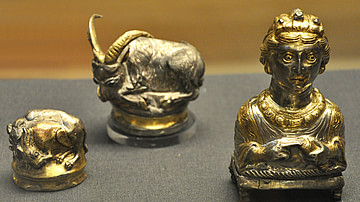
The Roman Hoxne Hoard
The Hoxne Hoard is the largest cache of late Roman gold found anywhere in the Roman Empire. Discovered by a metal detectorist in Suffolk, in the east of England in 1992 CE, the incredible collection contains 14,865 late-4th...

Article
Gibbon's Decline & Fall of the Roman Empire
The English historian Edward Gibbon (1737-1794) wrote and published his seminal work History of the Decline and Fall of the Roman Empire between 1776 and 1788. The dominant theme of Gibbon's six-volume work...
Article
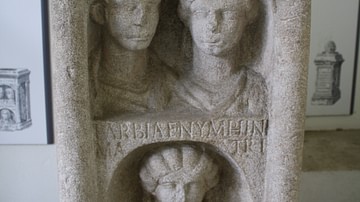
Ancient Roman Family Life
Whether there was a king, a consul, or an emperor that stood supreme over Rome and its territories, the one constant throughout Roman history was the family. Like many earlier societies, the family was the fundamental...

Definition
Roman Triumph
A Roman triumph was a spectacular celebration parade held in the ancient city of Rome for a military commander who had won an important victory on the battlefield. Granted by the Senate, it was a lavish and entertaining propaganda...
Article
The Battle of the Catalaunian Fields
The Battle of the Catalaunian Fields (also known as The Battle of Chalons, The Battle of Maurica) was one of the most decisive military engagements in history between the forces of the Roman Empire under Flavius...

Definition
Attila the Hun
Attila the Hun (r. 434-453 CE) was the leader of the ancient nomadic people known as the Huns and ruler of the Hunnic Empire, which he established. His name means "Little Father" and, according to some historians, may not have...

Article
The Battle of Zama - The Beginning of Roman Conquest
The Battle of Zama (202 BCE) was the final engagement of the Second Punic War (218-202 BCE) at which Hannibal Barca of Carthage (l. 247-183 BCE) was defeated by Scipio Africanus of Rome (l. 236-183...

Definition
Cimbri
The Cimbri were a tribe who lived in northern Jutland during the Roman era. Their ethnicity is enigmatic; scholars generally believe that the Cimbri were Germans, though others maintain that they were Celts. The late 2nd-century BCE migration...

Article
The Year of the Four Emperors & the Demise of Four Roman Legions
During the Year of the Four Emperors (69 CE), the fight between Vitellius and Vespasian would ultimately bring about the demise of four legions, the XV Primigenia, I Germanica, IIII Macedonica...
