
Search
Search Results
Article
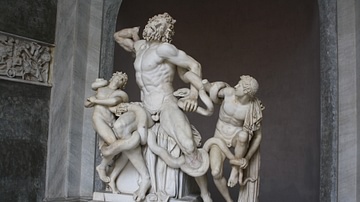
Laocoön: The Suffering of a Trojan Priest & Its Afterlife
The sculpture group of Laocoön and His Sons, on display in the Vatican since its rediscovery in 1506, depicts the suffering of the Trojan prince and priest Laocoön (brother of Anchises) and his young sons Antiphantes and Thymbraeus and is...

Article
Sioux Ceremonial Pipe
The Sioux ceremonial pipe is a sacred object of the Sioux nation used in the seven sacred rites as well as other observances to connect the people with the Great Spirit (Wakan Tanka), Mother Earth, the spirit world, and each other. Pipe rituals...

Article
The Book of Jonah
The book of Jonah is the fifth book in the Christian canons and the Jewish Tanakh. It is one of 'Trei Asar' (The Twelve) prophets in the tanakh, and in Christian tradition as 'oi dodeka prophetai' or 'ton dodekapropheton' , Greek for "The...

Article
The Batavian Revolt
Batavian revolt was a rebellion of the Batavians against the Romans in 69-70 CE. After initial successes by their commander Julius Civilis, the Batavians were ultimately defeated by the Roman general Quintus Petillius Cerialis. The year...

Article
Visitor's Guide to Ancient Dion
Dion is located at the foot of Mount Olympus in the north of Greece, in what would have been ancient Macedon. It takes its name from the most important Macedonian sanctuary dedicated to Zeus ("Dios” meaning "of Zeus”). Legend claims this...

Article
Louis XVI, the Girondins, & the Road to Revolutionary War (1791-92)
On 20 April 1792, King Louis XVI of France (r. 1774-1792) stood before the Legislative Assembly and, with a faltering voice, read a declaration of war against Austria, to the ecstatic delight of the gathered deputies. This declaration sealed...

Article
Oheka Castle
Oheka Castle, built by the industrialist Otto Herman Kahn (l. 1867-1934), is one of the best-known luxury hotels of Long Island, NY, USA today. In its time as a private residence, it was the site of the kind of lavish parties which inspired...

Article
The Wyndclyffe Estate
There are many fascinating and forlorn ruins throughout New York’s Hudson Valley, and, among them, the tottering remains of what was once considered the grandest home in the area and among the most famous in the country: Wyndclyffe. Between...
Article
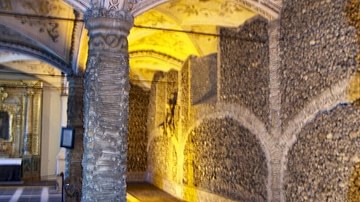
Skulls, Temples & Churches: A Visit to the Walled City of Evora
The sunbaked plain of the Alentejo region in central Portugal is called planicie dourada (golden plain) by the Portuguese, and it is dotted with cork oak forests, vineyards, olive groves, and hilltop towns with whitewashed houses. 'Alentejo'...

Definition
Byzantine Empire
The Byzantine Empire existed from 330 to 1453. It is often called the Eastern Roman Empire or simply Byzantium. The Byzantine capital was founded at Constantinople by Constantine I (r. 306-337). The Byzantine Empire varied in size over the...
