
Search
Remove Ads
Advertisement
Search Results
Image
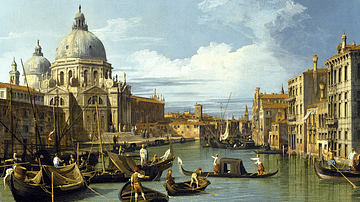
Entrance to the Grand Canal, Venice by Canaletto
A c. 1730 oil on canvas painting, Entrance to the Grand Canal, Venice, by the Italian artist Canaletto (1697-1768). (Museum of Fine Arts, Houston)

Image
Statue of St Oswald, Venice
A Statue of Saint Oswald, King of Northumbria (r. 634-642) on the front of the Church of San Stae, in Venice, Italy, by Italian artist Giuseppe Torretto (1661-1743).
Image
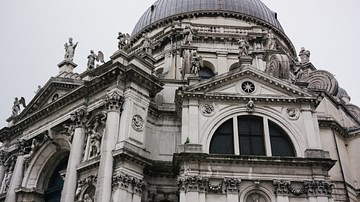
Santa Maria della Salute, Venice
Santa Maria della Salute in Venice. It is a striking example of Baroque architecture, constructed 1631-1687 CE.

Definition
Titian
Titian (c. 1487-1576 CE), real name Tiziano Vecelli (or Vecellio), was an Italian Renaissance painter who during his lifetime was considered the finest of the Venice school of artists. In a long career working for dukes, kings, and popes...

Image
Blue Venice by Manet
An 1875 oil on canvas painting, Blue Venice, by Edouard Manet (1832-83), the French modernist painter. Manet visited Venice in 1875 and produced some of his most impressionistic paintings. Apparently, Manet postponed his departure...
Definition
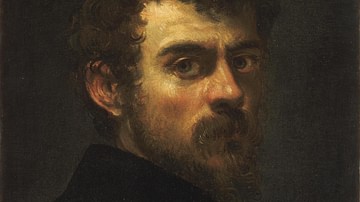
Tintoretto
Tintoretto (c. 1518-1594 CE), real name Jacopo Robusti, was an Italian Renaissance artist who specialised in religious, mythological, and portrait paintings. A prolific artist over a long career, the Venetian's masterpieces are famous...

Video
Venice & the Ottoman Empire: Crash Course
In which John Green discusses the strange and mutually beneficial relationship between a republic, the citystate of Venice, and an Empire, the Ottomans—and how studying history can help you to be a better boyfriend...

Image
San Giorgio Maggiore Church, Venice
The San Giorgio Maggiore Church in Venice. Designed by Andrea Palladio (1508-1580) in 1566, although not completed until 1610.

Image
Il Redentore, Venice by Palladio
Il Redentore church, Venice, designed by Andrea Palladio (1508-1580 CE) in 1576 CE.
Image
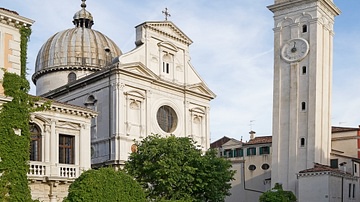
San Giorgio dei Greci Church, Venice
The San Giorgio dei Greci Church in Venice. Its present form dates to the 16th century CE. The church contains the tomb of the Byzantine scholar Arsenios (or Aristoboulos) of Monemvasia (1465-1535 CE).
