
Search
Did you mean: Ino?
Remove Ads
Advertisement
Search Results

Image
The Terracotta Army, Shaanxi Province
A row of life-size figures from the Terracotta Army buried near the tomb of Qin emperor Shi Huangdi, c. 210 BCE. Shaanxi Province, China.

Image
The Terracotta Army Panorama
The Terracotta Army which was buried near the tomb of Qin emperor Shi Huangdi, c. 210 BCE. There are up to 8,000 warriors, horses and chariots. Shaanxi Province, China.

Image
Terracotta Army
A portion of the Terracotta Army, the clay life-size army in the tomb of the Qin emperor Shi Huangdi. c. 210 BCE, Shaanxi Province, China.

Video
The incredible history of China's terracotta warriors - Megan Campisi and Pen-Pen Chen
This is a very good video on the Terracotta Warriors of China from the Qin Dynasty. It is less than five minutes long but provides a very thorough history lesson on who Shi Huangti was, why he had the terracotta army built, and how the tomb...

Definition
Ancient Chinese Warfare
In ancient China warfare was a means for one region to gain ascendancy over another, for the state to expand and protect its frontiers, and for usurpers to replace an existing dynasty of rulers. With armies consisting of tens of thousands...
Definition
Coinage
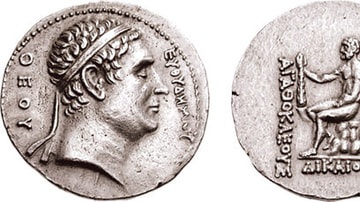
Coins were introduced as a method of payment around the 6th or 5th century BCE. The invention of coins is still shrouded in mystery: According to Herodotus (I, 94), coins were first minted by the Lydians, while Aristotle claims that the first...

Image
Imperial Dynasties of China Visual Timeline
The history of Chinese imperial rule traditionally begins with the semi-legendary Xia dynasty (traditionally dated c. 2070–1600 BCE) and unfolds through a succession of ruling houses that shaped one of the world’s most continuous state traditions...
Image
Banliang Coin
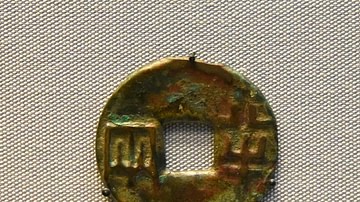
When Qin Shihuang (the First Emperor) unified the Warring States in 221 BCE, he standardized the coinage. He made the banliang (half-ounce) coin of the Qin State standard throughout the Empire, and declared all other coins obsolete. The round...

Article
The Art of the Han Dynasty
The art of the Han dynasty (206 BCE - 220 CE) of ancient China is characterised by a new desire to represent everyday life and the stories from history and mythology familiar to all. The arts were fuelled both by a political stability with...

Article
Armour in Ancient Chinese Warfare
With zinging arrows, powerful crossbow bolts, stabbing swords, and swinging axes all a staple feature of the Chinese battlefield, it is not surprising that soldiers sought to protect themselves as best they could with armour and shields...
