
Search
Did you mean: Ino?
Remove Ads
Advertisement
Search Results

Definition
Yang Zhu
Yang Zhu (l. 440-360 BCE, also known as Yang Chou or Yang Chu) was a hedonist philosopher who lived and wrote during The Warring States Period in China. Little is known of his life but his work survived through the writings of the great Confucian...

Video
An Introduction to the Dynasties of Ancient China
Ancient China produced what has become the oldest extant culture in the world, and this video is just an introduction to the different dynasties and rulers of Ancient China all the way up until the Song Dynasty. The Greeks and Romans knew...

Definition
Tang Dynasty
The Tang Dynasty (618-907 CE) was one of the greatest in Imperial Chinese history. It was a golden age of reform and cultural advancement which lay the foundation for policies which are still observed in China today. The second emperor, Taizong...

Definition
Warfare - The Development of Resources for Armed Conflict
Warfare is generally understood to be the controlled and systematic waging of armed conflict between sovereign nations or states, using military might and strategy, until one opponent is defeated on the field or sues for peace in the face...

Definition
Chang'an
Chang'an, located near modern Xian in Shaanxi Province, was the capital of several dynasties of ancient China from the Zhou to the Tang and eventually became one of the world's great metropolises. With regular tree-lined avenues, high walls...
Definition
Mo Ti
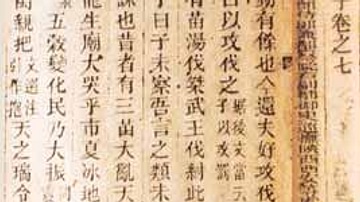
Mo Ti (l. 470-391 BCE, also known as Mot Tzu, Mozi, and Micius) was a Chinese philosopher of the Warring States Period (c. 481-221 BCE) associated with the Hundred Schools of Thought (different philosophical schools which established themselves...

Article
The Mandate of Heaven and The Yellow Turban Rebellion
Throughout history, in order for a government to be respected and obeyed, it must possess some form of legitimacy recognized by the governed. Governmental systems have relied on a number of models for legitimacy, among them the dynastic form...

Article
Fortifications in Ancient Chinese Warfare
While ancient Chinese warfare was often characterised by large armies in pitched battles, siege warfare and the sacking of cities were also regular features. Huge earth walls with towers and encircling ditches or moats became the normal strategy...

Definition
Chinese Literature
Chinese literature is among the most imaginative and interesting in the world. The precision of the language results in perfectly realized images whether in poetry or prose and, as with all great literature, the themes are timeless. The Chinese...

Image
Shi Huangdi
A statue of Shi Huangdi (259-210 BCE, also known as Qin Shi Huang, Qin Shih Huandi, Shih Huan-ti and Shi Huangti) who was the first emperor of a unified China. Xi'an, Shaanxi, China.
