
Search
Remove Ads
Advertisement
Search Results

Article
Life of Plato of Athens
Plato of Athens (424 or 423 to 347 BCE) was an ancient Greek philosopher whose work is considered so important that he may be called the inventor of philosophy as we understand the term today. Some people would want to reserve that honor...

Article
Capitals of the Roman Empire: Constantinople & Rome
Constantinople at first had much in common with the temporary capitals of the 2nd and 3rd century CE and the tetrarchic capitals. It was an existing city of medium size, well located on the road network, and unlike most of them, it was also...

Article
Julius Caesar in Britain
By the time he led his invasions of Britain, Julius Caesar (100-44 BCE) was already an experienced politician and successful military commander. As a member of a patrician family which claimed a pedigree reaching back even earlier than the...

Article
The Norse in America: Fact and Fiction
The idea that it was the Norse who discovered America first emerged in the late 18th century, long before there was any public awareness of the sagas on which such claims were based. In the course of the 19th century, evidence for a Norse...

Article
The Rise of Cities in the Ancient Mediterranean
The history of the ancient world has always been told as a history of cities, from Homer's epic poems about events just before and just after the sack of Troy, through the prose histories of wars between Athens and Sparta, Rome and Carthage...
Article
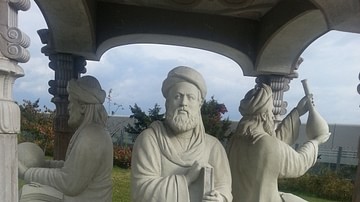
Ibn Sina, Biruni, and the Lost Enlightenment
Ibn Sina and Biruni were two of the most outstanding thinkers to have lived between ancient Greece and the European Renaissance. These two giants of a lost era of enlightenment were born in Central Asia about the year 980. For six hundred...

Article
Mark Antony's Parthian Campaign
In 36 BCE, Mark Antony (83-30 BCE) invaded Parthia, hoping to render himself one of the great conquerors of the Greco-Roman world, but he was stymied by Parthian forces and obliged to undertake an arduous, costly retreat. What to make of...

Article
Mikhail Kutuzov & the Russian Military Enlightenment
The Military Enlightenment of the 18th century was a concerted effort across Europe to engage with the science of war. Embracing rationalism and professionalism, especially in military education, statesmen, philosophers, and educators explored...

Article
Geme-Suen v Ur-Lugal's Wife - A Court Case in Ancient Mesopotamia
During the 21st century BCE, an era known as the Ur III period in Mesopotamia, many records of court hearings were drawn up in Umma, a city in what is now southern Iraq. One court record relates a dispute between two women. The name of one...

Article
Medieval Climate Anomaly in the Americas
To climatologists, the period of seven to twelve centuries ago was known as a "Climate Anomaly" or a "Warm Period" (800-1300 CE). To archaeologists, it was a time of great change, a period when cultural patterns were put into place that lasted...
