
Search
Remove Ads
Advertisement
Search Results

Article
Treasure Hoards in Ancient Literature
Aristophanes wrote in the 5th century BCE about coin hoards in Athens. He joked about the common saying, "No one knows but the birds where I hid my money," which led buffoons in his play to follow birds around...
Image
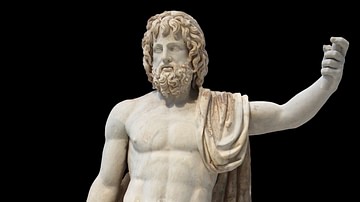
Jupiter with Eagle, Louvre
Statue of Jupiter with his trademark eagle. Marble, made c. 150 CE. (Louvre Museum)

Image
Menelaos & Helen
A scene from a red-figure vase showing Menelaos re-capturing Helen during the Trojan War. 480 BCE. (Staatliche Antikensammlungen, Munich)

Image
Helena of Constantinople
Statue of Saint Helena of Constantinople by Andrea Bolgi (1605-1656).
St. Peter's Basilica, Vatican.

Image
Eos & the Slain Memnon
Eos lifting up the body of her son Memnon in the so-called "Memnon Pieta" on the interior of an Attic red-figure cup, signed by Douris (painter) and Kalliades (potter), from Capua, Italy, c. 490-480 BCE.
Louvre, Paris.

Image
Roman Emperor Marcus Aurelius
Bust of Marcus Aurelius (reign 161–180 CE). Glyptothek, Munich, Germany.
Image
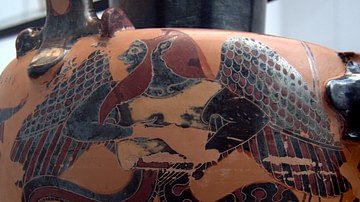
Typhon
The snake-monster Typhon of Greek mythology on a black-figure vase, 540-530 BCE.
Staatliche Antikensammlungen, Munich.
Image
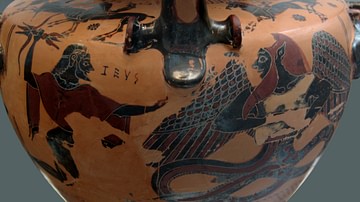
Zeus Aiming His Lighting Bolt at Typhon
Black-figure Chalcidian hydria, depicting Zeus, the king of the gods on the left, aiming his lightning bolt at Typhon, the father of monsters on the right, dated between 540-530 BCE. State Collections of Antiquities...

Image
Herakles in the Hesperides Garden
Herakles in the Hesperides garden. Side A from an Attic red-figure pelike, from Cyrenaica (Libya), 380-370 BCE.
Louvre, Paris.

Image
Uranus & Gaia
A Roman mosaic depicting the Greek primordial gods Uranus (in the guise of the later Aion) and Gaia. Sentinum, 3rd century CE. (Glyptothek, Munich)
