
Search
Remove Ads
Advertisement
Search Results

Definition
Anna Maria Weems - The Girl Who Became a Boy to Escape Slavery
Anna Maria Weems (circa 1840 to circa 1863) was an enslaved African American woman in Rockville, Maryland, who escaped by posing as a young Black livery man and carriage driver, assisted by...

Definition
New Testament
New Testament is the name for the second half of the Christian Bible, compiled from the 2nd century CE, after the separation of Christianity from Judaism. The Christian Bible retained books of the Jewish scriptures, the Old Testament...

Definition
Hoenir
Hoenir or Hönir (Old Norse: Hœnir or Hønir) is a very shadowy god figure in Norse mythology, who joins the gods Loki and Odin on a couple of occasions in the old texts. He seems to have attributes of creation and prophecy, and his name...

Definition
St. Bartholomew's Day Massacre
The St. Bartholomew's Day Massacre was a widespread slaughter of French Protestants (Huguenots) by Catholics beginning on 24 August 1572 and lasting over two months, resulting in the deaths of between 5,000 and 25,000...
Definition
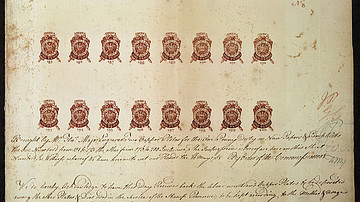
Stamp Act
The Stamp Act of 1765 was the first direct tax imposed on the 13 American colonies by the Parliament of Great Britain. It required the colonists to pay a tax on all printed materials including newspapers, legal documents, magazines...

Definition
Gisela of France
Gisela of France was a legendary 10th-century CE Francian princess, who, according to tradition, was married off to Viking leader Rollo of Normandy. Her name, Gisela or Gisla, comes from an Old German word meaning "to pledge"...

Definition
Louis I de Bourbon, Prince of Condé
Louis I de Bourbon (l. 1530-1569) was a descendant of Louis IX of France (r. 1226-1270) and founder of the House of Condé. The Prince of Condé proved his valor as a Huguenot military leader during the first three...

Definition
Artaxerxes I
Artaxerxes I (r. 465-424 BCE) was the sixth monarch of the Achaemenid Persian Empire. He was the son of Xerxes I (r. 486-465 BCE) and his principal wife Amestris (d. 424 BCE) and grandson of Darius I (the Great, r. 522-486 BCE...

Definition
Caligula - The First Mad Emperor of Rome
Caligula (12-41 CE) was the third Roman emperor, who reigned from 37 to 41 CE. A member of the Julio-Claudian Dynasty, he came to power after the death of his great-uncle Tiberius. The ancient sources claim...

Definition
Edward III of England
Edward III of England reigned as king from 1327 to 1377. Succeeding his father Edward II of England (r. 1307-1327) following his enforced abdication and then murder, Edward III would take revenge on his father's enemies, who...
