
Search
Remove Ads
Advertisement
Search Results

Image
Three Doctors Attend a Man with the Plague
Woodcutting of a plague-stricken man lying in bed, attended by three physicians. From the Pestbuch, a 16th Century CE medical treatise by Hieronymous Brunschwig (c. 1450-1512 CE). (Courtesy of the Historical...
Image
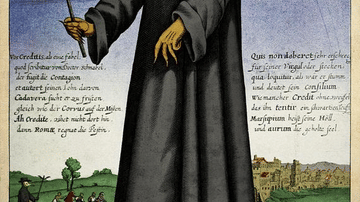
17th-century Depiction of Plague Doctor
A depiction of "Doctor Schnabel" ("Schnabel" is literally German for "Beak"), a plague doctor in Rome. The illustration appeared in a 17th -century German satirical manuscript. The engraving was first published...

Video
Americapox: The Missing Plague
Why didn't the Europeans get sick when they made contact with the American Indians?

Definition
Nergal - The Mesopotamian God of Death, War, and Destruction
Nergal (also known as Erra and Irra) is the Mesopotamian god of death, war, and destruction. He began as a regional, probably agricultural, god of the Babylonian city of Kutha in the Sumerian...

Definition
King's Evil
The king’s evil (from the Latin morbus regius meaning royal sickness), more commonly known as scrofula or medically tuberculous lymphadenitis, was a skin disease believed to be cured by the touch of the monarch as part of their inherited...

Image
The Roman Empire and the Crisis of the Third Century, c. 270 CE - Pretenders, Breakaways, Plague, and the Fight for Unity
The Crisis of the Third Century (235–284 CE) began with the assassination of Emperor Severus Alexander (reign 222–235 CE) in 235 CE, triggering...

Image
Moses & The Seventh Plague of Egypt
A 19th century CE painting by John Martin depicting the great storm which was the seventh plague of Egypt in the Moses story. (Museum of Fine Arts, Boston)

Image
Pharaoh, Victim of the 10th Plague of Egypt
A late 19th century CE painting by Tissot depicting Pharaoh as the victim of the tenth plague of Egypt where all first-born males are killed.

Image
The Plague by Arnold Bocklin
The Plague by Arnold Böcklin, 1827–1901 CE. (Kunstmuseum, Basel, Switzerland)

Article
Alexander's Siege of Tyre, 332 BCE
After defeating Darius III at the battle of Issus in November 333 BCE, Alexander marched his army (about 35,000-40,000 strong) into Phoenicia, where he received the capitulation of Byblus and Sidon. Tyrian envoys...
