
Search
Did you mean: Giza?
Remove Ads
Advertisement

 This answer was generated by
Search Results

Definition
Galileo Galilei
Galileo Galilei (1564-1642) was an Italian mathematician, physicist, astronomer, and natural philosopher. He created a superior telescope with which he made new observations of the night sky, notably that the surface of the Moon...
Definition
Pelops
Pelops was a Greek hero and king of Pisa in Greek mythology. As the son of Tantalus, he was a member of the cursed House of Atreus, and was cruelly sacrificed by his father in a twisted way to test the gods – an act that backfired and...
Article
Middle Eastern Power Shifts & the Trade of Pepper from East to West
Pepper has long been the king of spices and for almost 2,000 years dominated world trade. Originating in India, it was known in Greece by the 4th century BCE and was an integral part of...

Article
Prodigies: Earthquake Perception from Julius to L'Aquila
The beauty of being an archaeologist is having the good fortune to find something on an archaeological dig that remains in a relatively good state of preservation. In various degrees, there are...

Definition
Maximilian I, Holy Roman Emperor - The Great Matchmaker
Maximilian I, Holy Roman Emperor (1459-1519), belonged to the imperial House of Habsburg, and the imperial electors made him King of the Romans in 1486 during his father's lifetime, thus establishing...

Definition
Kingdom of Jerusalem
The Kingdom of Jerusalem was a state created in 1099 CE by Crusaders and western settlers after the First Crusade (1095-1102 CE). With Jerusalem as its capital, the kingdom was the most important of the four Crusader States...

Definition
Marcello Malpighi
Marcello Malpighi (1628-1694) was an Italian scientist and physician famous for discovering the capillaries of the human circulatory system in 1661 and, as the greatest anatomist of the Scientific Revolution, founding the science...
Image
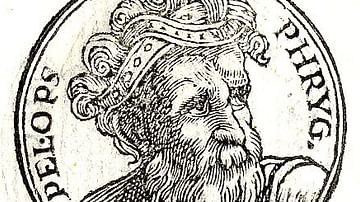
Pelops
Pelops, mythical king of Pisa and namesake of the Peloponnese. From the Promptuarii Iconum Insigniorum (Handbook of the Images of the Renowned), an iconography book by Guillaume Rouillé, 1553.

Article
The Crusades: Consequences & Effects
The crusades of the 11th to 15th century CE have become one of the defining events of the Middle Ages in both Europe and the Middle East. The campaigns brought significant consequences wherever they occurred but...

Article
Trade in Medieval Europe
Trade and commerce in the medieval world developed to such an extent that even relatively small communities had access to weekly markets and, perhaps a day's travel away, larger but less frequent fairs, where the full range...
