
Search
Remove Ads
Advertisement
Search Results

Definition
Neptune
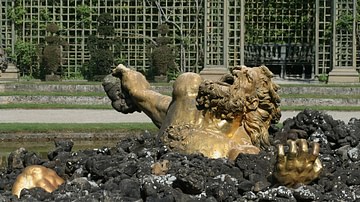
Neptune is the Roman god of the sea and the Roman equivalent of the Greek god Poseidon. He was originally a god of fresh water and became associated with Poseidon early on in Roman history. He lives in a golden palace at the bottom of...
Definition
Giants
In Greek mythology, the Giants (Gigantes) are an aggressive race of creatures who were born from Gaia (the Earth) after drops of Uranus' blood fell on the Earth after he was castrated. The Giants had great strength and were fearsome to...

Definition
Vulcan
Vulcan or Volcanus was the Roman god of fire and forge, the equivalent of Hephaestus from Greek mythology. The son of Jupiter and Juno, he was the special patron of blacksmiths and artisans. As the god of the forge and the devastating...

Definition
Hermes - The Messenger of the Olympian Gods
Hermes was the ancient Greek god of trade, wealth, luck, fertility, animal husbandry, sleep, language, thieves, and travel. One of the cleverest and most mischievous of the 12 Olympian gods, Hermes was their...
Definition
Perseus
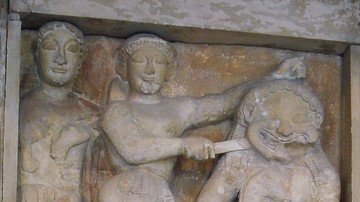
Perseus is one of the greatest and oldest pan-Hellenic heroes of Greek mythology. Perseus famously killed the dreaded Medusa, a Gorgon with snakes as hair and whose stare turned men to stone. Perseus also carried out the daring rescue...

Definition
Baldr
Baldr is a god in Norse mythology associated with light, wisdom, and courage, although he is never specifically defined as the god of any of these. He is best known for his dramatic death, which heralds the coming of Ragnarök, the end...

Definition
Helen of Troy
Helen of Troy (sometimes called Helen of Sparta) is a figure from Greek mythology whose elopement with (or abduction by) the Trojan prince Paris sparked off the Trojan War. Helen was the wife of Menelaus, the king of Sparta, and...

Definition
Ull
Ull (also known as Ullr), with his bow and skis, is such an elusive presence in Norse mythology that no conclusive remarks can be made about him. The 13th-century Icelandic author Snorri describes him only briefly in his Prose Edda, and...

Definition
Sleipnir
Sleipnir is the eight-legged horse ridden primarily by the god Odin in Norse mythology. He is the son of the god Loki (in the form of a mare) and the stallion Svadilfari who belonged to the jötunn that built the walls of Asgard. In...
Definition
Antiochia ad Cragum
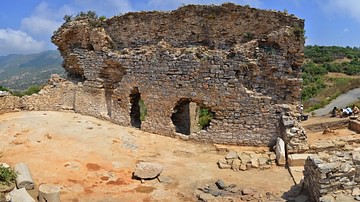
Antiochia ad Cragum (“Antioch on the Cliffs” or “Antioch at Cragus”) was a Hellenistic Roman city located in Cilicia Trachea (“Rough Cilicia”, also known as Cilicia Aspera and Cilicia Secunda) on the southern coast of modern-day...
