
Search
Did you mean: Peltast?
Remove Ads
Advertisement
Search Results

Definition
Peasants' Revolt
The Peasants' Revolt, also known as the Great Revolt, was a largely unsuccessful popular uprising in England in June 1381. The rebellion's leaders included Wat Tyler and they wanted massive social changes which included a removal...

Article
Religion in the Middle Ages
Religion in the Middle Ages, though dominated by the Catholic Church, was far more varied than only orthodox Christianity. In the Early Middle Ages (c. 476-1000), long-established pagan beliefs and practices entwined...

Article
Müntzer's Vindication and Refutation
The Vindication and Refutation of Thomas Müntzer (l. c. 1489-1525) is a 1524 open letter to Jesus Christ, Martin Luther (l. 1483-1546), and the Christian community charging Luther with hypocrisy, betraying his...

Definition
Serf
Medieval serfs (aka villeins) were unfree labourers who worked the land of a landowner (or tenant) in return for physical and legal protection and the right to work a separate piece of land for their own basic needs. Serfs made up 75%...

Definition
Hongwu Emperor
The Hongwu Emperor (r. 1368-1398 CE) was the founder of the Ming dynasty (1368-1644 CE) which took over from the Mongol Yuan dynasty (1276-1368 CE) as the rulers of China. Born a peasant with the name Zhu Yuanzhang, the future...

Article
Lenin's New Economic Policy - Communism's Flirtation with Capitalism
The New Economic Policy (NEP) of Vladimir Lenin (1870-1924), leader of Soviet Russia, was the introduction in 1921 of a limited form of capitalism in light industry and agriculture. Contrary...

Definition
Ancient China
Ancient China produced what has become the oldest extant culture in the world. The name 'China' comes from the Sanskrit Cina (derived from the name of the Chinese Qin Dynasty, pronounced 'Chin') which was translated as 'Cin' by...
Definition
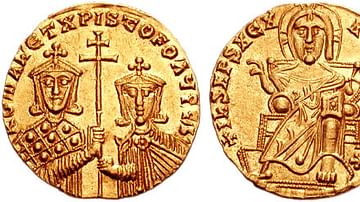
Romanos I
Romanos I Lekapenos (“the Ignorant”) was emperor of the Byzantine Empire from 920 to 944 CE. Of Armenian descent, he was a military commander who usurped the throne to rule as co-emperor with the rightful heir, but still minor, Constantine...

Article
Causes of the Russian Revolution of 1917
There were many causes behind the Russian Revolution of 1917, ranging from the unpopular authoritarian rule of Tsar Nicholas II (reign 1894-1917) to the radical mobilisation of the working class, who wanted...

Article
Cosmetics, Perfume, & Hygiene in Ancient Egypt
For the ancient Egyptians life was a celebration, and so, just as one would want to look one's best at any party, personal hygiene was an important cultural value. The Egyptians bathed daily, shaved their...
