
Search
Remove Ads
Advertisement
Search Results

Definition
William Brewster
William Brewster (l. 1568-1644 CE) was an elder of the Leiden congregation of separatists (later known as pilgrims) and their spiritual leader while onboard the Mayflower and later after the establishment of the Plymouth Colony...

Definition
John Smith
Captain John Smith (l. 1580-1631 CE) was an English explorer, soldier, author, and early governor of the Jamestown Colony of Virginia between 1607-1609 CE. Smith had served as a mercenary in his younger years and was well-versed in...
Definition
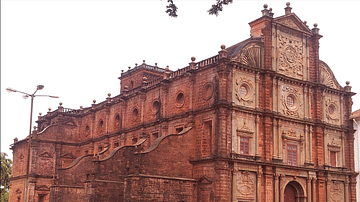
Portuguese Goa
Goa, located on the west coast of India, was a Portuguese colony from 1510 to 1961. The small coastal area was conquered by Afonso de Albuquerque (c. 1453-1515) and became an important trade hub for the Eastern spice trade. Goa...

Definition
Jean-Baptiste Jourdan
Jean-Baptiste Jourdan (1762-1833) was a French general who held significant commands in the French Revolutionary Wars (1792-1802) and the Napoleonic Wars (1803-1815). He won a major victory for the French Republic at the Battle...
Definition
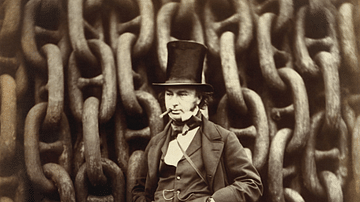
Isambard Kingdom Brunel
Isambard Kingdom Brunel (1806-1859) was a British engineer and a key figure of the British Industrial Revolution (1760-1840). Brunel masterminded the Great Western Railway from London to Bristol, designed and built innovative...

Definition
Johann Sebastian Bach
Johann Sebastian Bach (1685-1750) was a German organist and composer whose work is today regarded as amongst the finest of mature baroque music (c. 1600-1750). More famous as an organist than as a composer in his own lifetime...

Definition
Thaddeus Stevens - American Jacobin
Thaddeus Stevens (1792-1868) was a US politician and abolitionist, who rose to prominence in the 1860s during the American Civil War and Reconstruction eras. A leader of the abolitionist wing of the Republican Party...

Definition
Sargon II
Sargon II (r. 722-705 BCE) was one of the most important kings of the Neo-Assyrian Empire as founder of the Sargonid Dynasty which would rule the empire for the next century until its fall. He was a great military leader, tactician...

Definition
Ancient Egypt - The Land of the Gods of Balance and Harmony
Egypt is a country in North Africa, on the Mediterranean Sea, and is home to one of the oldest civilizations on Earth. The name "Egypt" comes from the Greek Aegyptos, which was the Greek pronunciation...

Definition
Neo-Assyrian Empire
The Neo-Assyrian Empire (912-612 BCE) was the final stage of the Assyrian Empire, stretching throughout Mesopotamia, the Levant, Egypt, Anatolia, and into parts of Persia and Arabia. Beginning with the reign of Adad Nirari...
