
Search
Remove Ads
Advertisement
Search Results

Definition
French and Indian War - The Final Clash of Empires in North America
The French and Indian War (1754-1763) was the last great colonial conflict waged between Great Britain and France in North America. Often considered a theater of the global Seven Years'...

Definition
Zephyrus
Zephyrus was the god of the west wind and the messenger of spring in Greek mythology. He was known as one of the four Anemoi, or wind gods, each of whom represented a cardinal direction and, except for Eurus, a season. Zephyrus was...
Definition
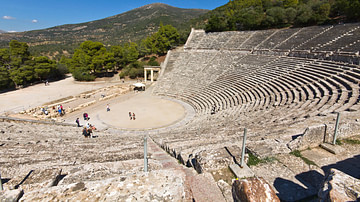
Epidaurus
Epidaurus was an ancient religious site and settlement located on the fertile Argolid plain of the east Peloponnese in Greece. Blessed with a mild climate and natural springs, the sanctuary of Asclepius at Epidaurus was an important...

Definition
Shiva
Shiva (Siva) is one of the most important gods in Hinduism and a member of the holy trinity (trimurti) with Brahma and Vishnu. Shiva is a complex character who may represent goodness and benevolence, and he serves as the Protector. Shiva...

Definition
William IV of Great Britain
William IV of Great Britain (r. 1830-1837) succeeded his elder brother George IV of Great Britain (r. 1820-1830) to become the fifth Hanoverian monarch. William had a successful naval career, and his reign is best remembered...

Definition
Ninurta - The Sumerian Hero-God of War
Ninurta (identified with Ningirsu, Pabilsag, and the biblical Nimrod) is the Sumerian and Akkadian hero-god of war, hunting, and the south wind. He first appears in texts in the early 3rd millennium BCE as an...

Definition
Buddhism
Buddhism is a non-theistic religion (no belief in a creator god), also considered a philosophy and a moral discipline, originating in the region of modern-day India in the 6th and 5th centuries BCE. It was founded by the sage Siddhartha...

Definition
Ganesha
Ganesha (also Ganesa or Ganapati) is one of the most important gods in Hinduism. Ganesha is easily recognized with his elephant head and human body, representing the soul (atman) and the physical (maya). Ganesha is the patron of writers...

Definition
Izanami and Izanagi
Izanami ('she who invites') and Izanagi ('he who invites') are the primordial gods of the Shinto religion who are believed to have created the islands of Japan and given birth to many of the other Shinto gods or kami. The...

Definition
Hecate
Hecate (Hekate) is a goddess of Greek mythology capable of both good and evil. She was associated with witchcraft, magic, the Moon, doorways, and creatures of the night like hell-hounds and ghosts. Hecate often carries a torch in her...
