
Search
Remove Ads
Advertisement
Search Results

Definition
Ajanta
Approximately 67 miles (107 km) to the north of Aurangabad in the Indhyadri range of Western Ghats lie the caves of Ajanta. The 30 caves, famous for their early Buddhist temple architecture and many delicately drawn murals, are located...
Definition
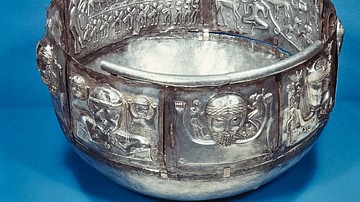
Gundestrup Cauldron
The Gundestrup Cauldron is a gilded silver bowl found in Gundestrup in Denmark in 1891 CE. It was likely made in the Balkans, perhaps in the 1st century BCE, and shows a clear influence from Celtic art and mythology, even if...

Definition
Raphael
Raphael (1483-1520) was an Italian painter and architect who is regarded as one of the greatest of Renaissance artists alongside Michelangelo (1475-1564) and Leonardo da Vinci (1452-1519). Raphael's works are celebrated for their harmonious...

Article
The Unicorn Myth
The unicorn, a mythical creature popularized in European folklore, has captivated the human imagination for over 2,000 years. For most of that time, well into the Middle Ages, people also believed them to be real. The roots of...

Definition
Andrea Mantegna
Andrea Mantegna (c. 1431-1506 CE) was an Italian Renaissance artist most famous for his use of foreshortening and other perspective techniques in engravings, paintings, and frescoes. Another common feature of Mantegna's work is...

Video
Persian Art
Images of Persian art accompanied by a poem by Rumi (1207 - 1273 CE) and Persian music.
Image
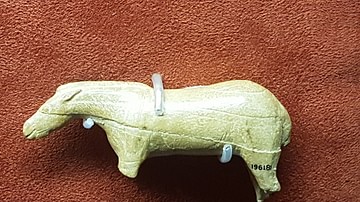
Magdalenian Horse Figurine
Cast of a horse figurine carved out of mammoth ivory belonging to the Magdalenian industry of the Upper Paleolithic, which is associated with early modern humans (Homo sapiens) in southwestern France between c. 17,000...

Video
Japanese Art History: Jomon, Yayoi and Kofun Periods
The art of Neolithic Jomon and the Protohistoric Yayoi and Kofun periods of Japan.

Video
Japanese Art History: Asuka & Nara Periods
The Impact of China and Buddhism on Japanese art during the Asuka and Nara Periods.
Image
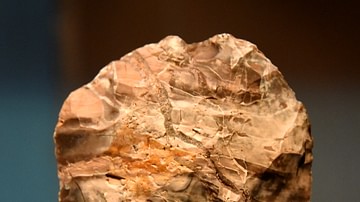
Flint Hand Axe
Paleolithic flint hand axe from modern-day Azraq, Jordan Hashemite Kingdom, 300,000-250,000 years BCE.
The Jordan Museum, Amman, Jordan.
