
Search
Remove Ads
Advertisement
Search Results

Definition
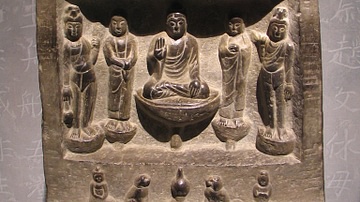
Samudragupta
Samudragupta (r. 335/350 - 370/380 CE) was the first significant ruler of the Gupta Dynasty. Having come to the throne, he decided to extend the boundaries of his empire to cover the multiple kingdoms and republics that existed outside...
Definition
Balhae
The Balhae (Parhae) kingdom in Manchuria (698-926 CE) was an important regional power which interacted both peacefully and otherwise with its neighbours the Unified Silla Kingdom of Korea and Tang China. The latter was a strong cultural...

Definition
Gustav Mahler
Gustav Mahler (1860-1911) was an Austrian-Bohemian composer best known for his song-cycles and his grand, sweeping symphonies, which often require expanded orchestras for their full performance. Mahler, a composer of Late-Romantic...

Definition
Locarno Pact - The Treaty that Won the Nobel Peace Prize
The Locarno Pact, actually a group of seven treaties (hence its other name: the Locarno Treaties), was signed on 1 December 1925 with the aim that peace continued in Europe despite the German government's...

Definition
Pushyabhuti Dynasty
The Pushyabhuti Dynasty (c. 500 CE - 647 CE) rose after the downfall of the Gupta Empire (3rd century CE - 6th century CE) in the 6th century CE in northern India. Also known as the Vardhana or Pushpabhuti Dynasty, the core...

Definition
Lycurgus
Lycurgus is considered the semi-mythical founder of classical Sparta and responsible for all of the city-state’s laws as well as its military and political institutions. He became better known to generations of Spartans as the lawgiver...

Definition
Kellogg-Briand Pact - When 63 States Signed Up for Peace
The Kellogg-Briand Pact was an agreement signed in August 1928 by 63 countries, which all promised, after the horrors of the First World War (1914-18), to regard war as an illegal instrument of...
Definition
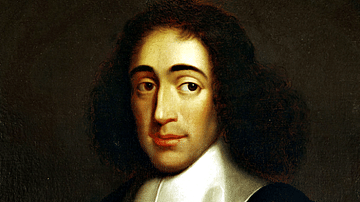
Baruch Spinoza
Baruch Spinoza (1632-1677) was a Dutch philosopher who combined rationalism and metaphysics to create a unique system of thought. Spinoza was held up as an atheist philosopher in the 18th century, but this is not an entirely accurate...

Definition
Zoroastrianism
Zoroastrianism is the monotheistic faith established by the Persian prophet Zoroaster (also given as Zarathustra, Zartosht) between c. 1500-1000 BCE. It holds that there is one supreme deity, Ahura Mazda (Lord of Wisdom), creator...

Definition
Portuguese Empire
The Portuguese Empire was established from the 15th century and eventually stretched from the Americas to Japan. Very often a string of coastal trading centres with defensive fortifications, there were larger territorial colonies...
