
Search
Remove Ads
Advertisement
Search Results

Definition
Samos
Samos is a Greek island in the east Aegean, just off the coast of modern-day Turkey. It particularly flourished in the 6th century BCE and was famous in antiquity for its navy, wine, and important sanctuary to Hera. Samos was an active...

Definition
Acropolis
An acropolis is any citadel or complex built on a high hill. The name derives from the Greek akro, "high" or "extreme/extremity" or "edge", and polis, "city", translated as "high city", "city on the edge" or "city in the air", the...

Definition
Labyrinth
The word labyrinth comes from the Greek labyrinthos and describes any maze-like structure with a single path through it which differentiates it from an actual maze which may have multiple paths intricately linked. Etymologically the...

Definition
Korean Pottery
The pottery of ancient Korea stretches back to prehistory when simple brown wares were made and decorated with geometrical incisions. Potters would benefit from the ideas and techniques of their Chinese counterparts and go on to...

Definition
Homo Sapiens
Homo sapiens ('wise man'), or modern humans, are the only species of human still around today. Despite having invented countless ways of labelling the world around us, we have so far done a surprisingly poor job at defining ourselves...

Definition
Near East - A Modern Term for an Ancient Land
The 'Near East' is a modern-age term for the region formerly known as the 'Middle East,' comprising Armenia, Cyprus, Egypt, Iraq, Iran, Israel, Jordan, Lebanon, Palestine, Syria, and part of Turkey, corresponding...
Definition
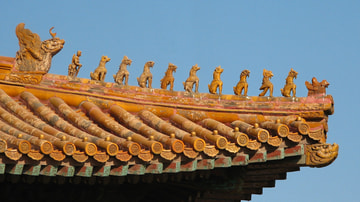
Ancient Chinese Architecture
Walled compounds, raised pavilions, wooden columns and panelling, yellow glazed roof tiles, landscaped gardens, and a careful application of town planning and use of space are all notable features of the architecture...

Definition
Mali Empire
The Mali Empire (1240-1645) of West Africa was founded by Sundiata Keita (r. 1230-1255) following his victory over the kingdom of Sosso (c. 1180-1235). Sundiata's centralised government, diplomacy and well-trained army permitted a...

Definition
Bronze Age Aegean
The Bronze Age (c. 3000-1000 BCE) is the period when cultures were either using, producing, or trading bronze. Several cultures flourished around the Aegean Sea during this period: the Minoan civilization on Crete, the Mycenaean...
Definition
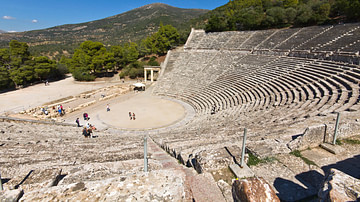
Epidaurus
Epidaurus was an ancient religious site and settlement located on the fertile Argolid plain of the east Peloponnese in Greece. Blessed with a mild climate and natural springs, the sanctuary of Asclepius at Epidaurus was an important...
