
Search
Did you mean: Acropolis?
Remove Ads
Advertisement
Search Results
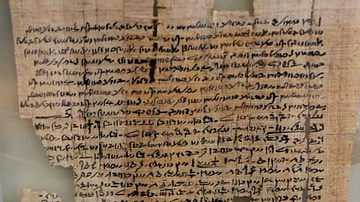
Image
Demotic Embalmer's Agreement
This document contains an agreement between one group of lector-priests of the necropolis of To-ankh at Asyut, and another group, defining which persons were to be employed in the ceremonies of mummification, and what materials were to be...
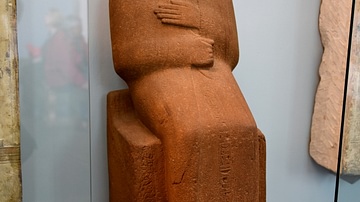
Image
Statue of Rehuankh
Rehuankh was mayor of Abydos, where Osiris (the god of death and the afterlife) had his principal temple. He was also a "senior lector priest": a scholar with knowledge of rituals and sacred texts. The inscriptions on this statue are of unusual...

Definition
Middle Kingdom of Egypt - Ancient Egypt's Classical Age
The Middle Kingdom (2040-1782 BCE) is considered ancient Egypt's Classical Age, during which it produced some of its greatest works of art and literature. Scholars remain divided on which dynasties constitute the Middle Kingdom, as some argue...

Article
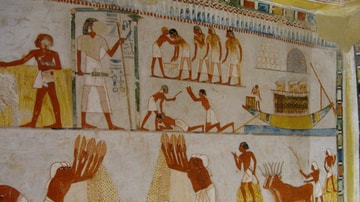
Daily Life in Ancient Egypt
The popular view of life in ancient Egypt is often that it was a death-obsessed culture in which powerful pharaohs forced the people to labor at constructing pyramids and temples and, at an unspecified time, enslaved the Hebrews for this...
Article
Social Structure in Ancient Egypt
The society of ancient Egypt was strictly divided into a hierarchy with the king at the top and then his vizier, the members of his court, priests and scribes, regional governors (eventually called 'nomarchs'), the generals of the military...

Article
Mummification in Ancient Egypt
The practice of mummifying the dead began in ancient Egypt c. 3500 BCE. The English word mummy comes from the Latin mumia which is derived from the Persian mum meaning 'wax' and refers to an embalmed corpse which was wax-like. The idea of...

Article
Clergy, Priests & Priestesses in Ancient Egypt
The ancient Egyptians understood that their gods had prevailed over the forces of chaos through the creation of the world and relied upon humanity's help to maintain it. The people of Mesopotamia held this same belief but felt they were co-workers...

Article
Egyptian Afterlife - The Field of Reeds
The ancient Egyptians believed that life on earth was only one part of an eternal journey which ended, not in death, but in everlasting joy. When one's body failed, the soul did not die with it but continued on toward an afterlife where one...

Article
The Roman Funeral
The Roman funeral was a rite of passage that signified the transition between the states of life and death. It was very important to conduct the proper ceremonies and burial in order to avoid having a malicious spirit rising from the underworld...

Article
The Mystery of the Great Sphinx
Buried for most of its life in the desert sand, an air of mystery has always surrounded the Great Sphinx, causing speculation about its age and purpose, method of construction, concealed chambers, role in prophecy, and relationship to the...
