
Search
Did you mean: Acropolis?
Remove Ads
Advertisement
Search Results

Definition
Third Dynasty of Egypt
The Third Dynasty of Egypt (c. 2670-2613 BCE) begins with king Djoser, famous for his Step Pyramid at Saqqara. Although there are some sources which claim a king named Sanakht (also known as Nebra) founded the Third Dynasty, these claims...

Definition
Cerveteri
Cerveteri (Etruscan name: Cisra or Caisra, Greek: Agylla, Roman: Caere) was an important Etruscan town which flourished between the 7th and 4th century BCE. Located near the western coast of central Italy, around 50 km north of Rome, Cerveteri...

Definition
Parthian Art
Parthian art flourished within the Eurasian cultural corridor from the late hundreds BCE to the early 1st and 2nd centuries CE. With the Parthian Empire (247 BCE - 224 CE) stretching from India and China in the east to the Mediterranean shores...
Definition
Vulci
Vulci (Velch) was an Etruscan city located 12 km from the western coast of central Italy by the banks of the Fiora River. Flourishing as a trading port between the 6th and 4th century BCE, it was an important member of the Etruscan League...
Definition
Faras
Faras was an important town near Abu Simbel in southern Egypt/northern Kush (modern-day Sudan). It was a center of trade and administrative offices which was founded between 2040-1750 BCE. In the New Kingdom (1550-1070 BCE) a temple to Hathor...

Definition
Aytap
Aytap is the modern name for the ancient city of Iotapa (sometimes given as Iotape and Iotape Philadelphos) in Cilicia. The city's ruins are located in southern Turkey near modern day Alanya (ancient Coracesium). The city was founded in 52...
Definition
Hamaxia
Hamaxia (now known as Sinek Kalesi or Sinekkalesi, near the modern Alanya) was a city in western Cilicia in southern Turkey known for its lush landscape, cedar forests, and thriving timber export business. It was located on a high hill near...
Image
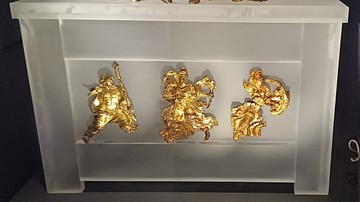
Macedonian Burial Casket Decorations from Pydna
Grave goods from a male burial in the necropolis of Pydna, c. 330 BCE. Archaeological Museum of Thessaloniki, acc. no. Py4285. The ancient city of Pydna (near today's small town of Makrygialos) was a semi-independent harbour by the Thermaic...
Image
Early Bronze Age Bell Beakers from Iberia
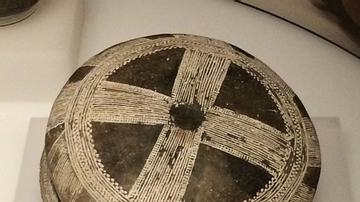
These clay bell beakers come from the Early Bronze Age necropolis of Ciempozuelos (Cuesta de la Reina, Madrid), Spain and they were found during excavations conducted in the late 19th century CE. (Ciempozuelos was the first Bell-Beaker necropolis...
Image
Demotic Embalmer's Agreement
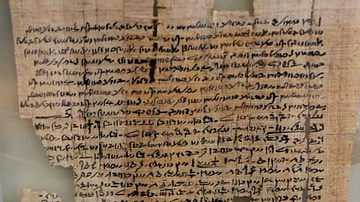
This document contains an agreement between one group of lector-priests of the necropolis of To-ankh at Asyut, and another group, defining which persons were to be employed in the ceremonies of mummification, and what materials were to be...
