
Search
Remove Ads
Advertisement
Search Results

Image
Mycenaean Lion Rhyton
A gold rhyton in the form of a lion's head. From Grave Circle A, Mycenae, 16th century BCE. (National Archaeological Museum, Athens)
Image
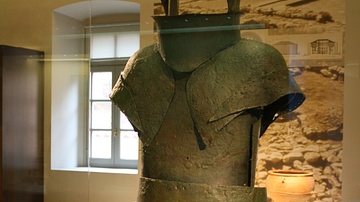
Mycenaean Bronze Armour
Bronze armour and boar tusk helmet (15th century BCE) from a mycenaean cemetery in Dendra. Nafplio Archaeological Museum.
Image
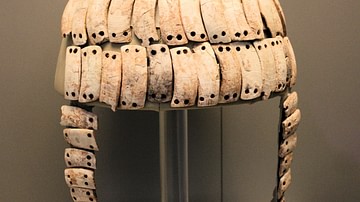
Mycenaean Boar's Tusk Helmet
Mycenaean boar's tusk helmet excavated from chamber tomb 515. A description of this type of helmet can be found in Homer's 'Iliad'. 14th - 13th cents. BCE. Currently housed at the National Archaeological Museum of Athens...

Image
Mycenaean Gold Sword Hilt
A Mycenaean gold sword hilt with bronze blade. From a tomb in Skopelos, 15th century BCE. (National Archaeological Museum, Athens)
Image
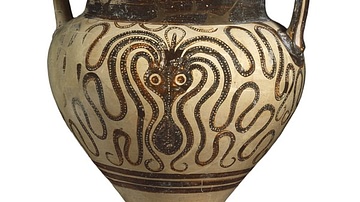
Mycenaean Vase Decorated With An Octopus
A Mycenaean vase or krater depicting a stylized octopus (1400-1300 BCE). Provenance: Ialysos, Rhodes. (British Museum).
Image
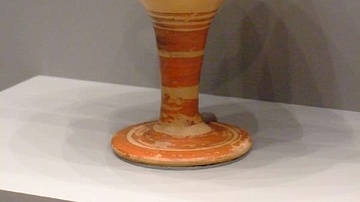
Mycenaean Stemmed Cup
A Mycenaean stemmed cup (1350-1300 BCE) in terracotta and depicting stylized seashells. (The Getty Villa, Malibu, USA).
Image
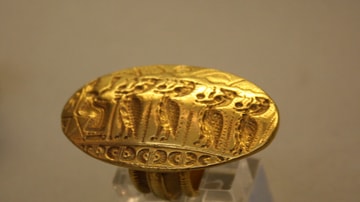
Mycenaean Engraved Gold Ring
A gold ring from Mycenaean Tiryns, the largest such example. The engraved scene depicts lion-headed creatures in a religious procession carrying libation vases. On the left side is a seated goddess. 15th century BCE...

Image
Mycenaean Agora at Hagia Triada, Crete
The Agora (marketplace) at the Minoan settlement of Hagia Triada (Crete) belonging to the Mycenaean era (1400-1100 BCE) with eight spacious rooms, probably shops, arranged behind a portico.

Collection
Warfare in Classical Greece
The ancient Greek city-states were in a constant rivalry for land, resources and power which meant that warfare became an ever-present aspect of life. Athens and Sparta were famous rivals throughout the Classical period...
Article
Trade & Warfare in the Kievan Rus
Scandinavians from the island of Gotland began to spread throughout the Baltic region along the Russian rivers in the 700s. While the Vikings of Norway and Denmark from the 8th to 11th centuries are widely recognized...
