
Search
Did you mean: Muse?
Remove Ads
Advertisement
Search Results
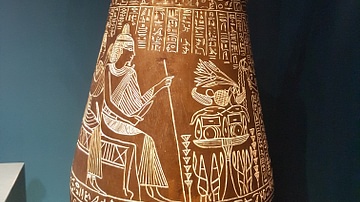
Image
Situla Of Hor
Situla of Hor, end of the Late Period to the beginning of the Ptolemaic Period, about 350-280 BCE. From Thebes, Egypt. The British Museum (photo taken at The Powerhouse Museum, Sydney, Australia). Situlae were important vessels...
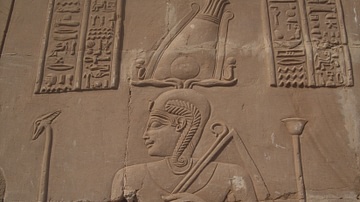
Image
Relief of Khonsu, Deir el-Hagar
Detail of Khonsu on a larger relief depicting the god alongside Mut and Amun making offerings to the Roman Emperor. Temple of Deir el-Hagar, Dakhla Oasis. 1st Century CE, Roman era. Image used courtesy of Ancient World...
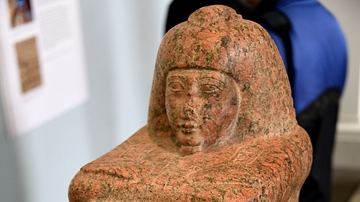
Image
Block Statue of Ankhrenepnefer
The owner was "a great commissioner of the palace" for Osorkon II, whose cartouches of birth and throne names appear on the upper arm. The shrine he presents contains a figure of Atum, the creator god of Heliopolis...
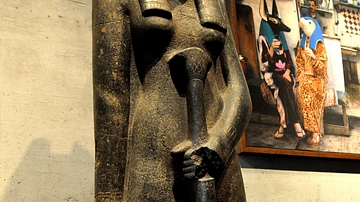
Image
Goddess Sekhmet Statue
Granite standing figure of goddess Sekhmet. From goddess Mut temple at Karnak, modern-day Egypt. New Kingdom, 19th Dynasty,circa 1250 BCE. (State Museum of Egyptian Art, Munich, Germany).

Image
Avenue of the Sphinxes, Thebes
The Avenue of the Sphinxes is a 3-km ancient processional route that once linked Luxor temple with the Temple of Mut at Karnak to the south. The avenue and sphinxes were built during the reign of Nectanebo I (380-363...

Image
Fragment of a Menat Necklace
This bronze fragment (with gold insoles) was part of a Menat (also Minet) necklace. On the right, a child-god, wearing a rearing cobra (uraeus) on his head stands before the goddess Mut-Sekhmet-Bastet. The child-god...

3D Image
Karnak Temple - 3D View
Cult temple dedicated to Amun, Mut and Khonsu. The largest religious building ever constructed. The temple of Karnak was known as Ipet-isu—or “most select of places”—by the ancient Egyptians. It is a city of temples built...
