
Search
Remove Ads
Advertisement
Search Results

Definition
Parthian Religion
Parthian religion might be best described with two words: inclusive and evolving. As Parthia's empire held within it a variety of cultures, the Parthians wisely left each to their own beliefs and traditions, like the Seleucid...

Definition
Genghis Khan
Genghis Khan (aka Chinggis Khan) was the founder of the Mongol Empire which he ruled from 1206 until his death in 1227. Born Temujin, he acquired the title of Genghis Khan, likely meaning 'universal ruler’, after unifying the Mongol...

Definition
Basil II
Basil II (aka Basilius II) was the emperor of the Byzantine Empire from 976 to 1025 CE. He became known as the Bulgar-Slayer (Bulgaroktonos) for his exploits in conquering ancient Bulgaria, sweet revenge for his infamous defeat at Trajan's...

Article
Byzantine-Armenian Relations
The relationship between the Byzantine Empire and ancient Armenia was a constant and varied one with an equal mix of wars, occupations, treaties of friendship, mutual military aid, and cultural exchange. Regarded as...
Definition
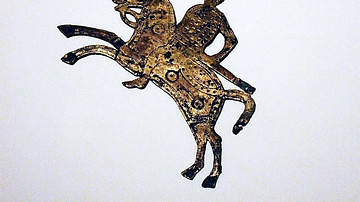
Lombards
The Lombards were a Germanic tribe that originated in Scandinavia and migrated to the region of Pannonia (roughly modern-day Hungary). Their migration is considered part of "The Wandering of the Nations" or "The Great Migration", which...

Definition
Constantine I
Constantine I, aka Constantine the Great, was Roman emperor from 306 to 337 CE. Realizing that the Roman Empire was too large for one man to adequately rule, Emperor Diocletian (284-305 CE) split the empire into two, creating a...
Definition
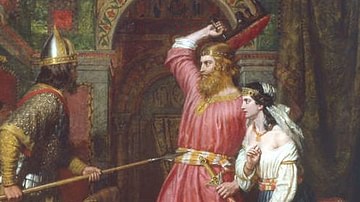
Alboin
Alboin (r. 560-572 CE) was a king of the Lombards who led his people into Italy and founded the Kingdom of the Lombards which lasted from 568-774 CE. His father was Audoin, King of the Lombards, and his mother Queen Rodelinda. He was...
Definition
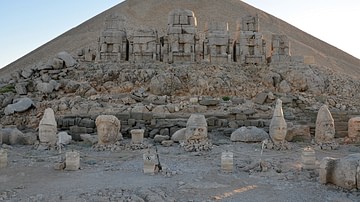
Commagene
The Kingdom of Commagene (163 BCE - 72 CE) was a Hellenistic political entity, heavily influenced by Armenian and ancient Persian culture and traditions, established in southwestern Anatolia (modern-day Turkey) by Ptolemaeus of Commagene...

Definition
Islam
Islam is an Abrahamic-monotheistic religion based upon the teachings of Prophet Muhammad ibn Abdullah (l. 570-632 CE, after whose name Muslims traditionally add “peace be upon him” or, in writing, PBUH). Alongside Christianity and Judaism...

Definition
Persian Literature
Persian literature differs from the common definition of “literature” in that it is not confined to lyrical compositions, to poetry or imaginative prose, because the central elements of these appear, to greater or lesser degrees...
