
Search
Did you mean: Consul?
Remove Ads
Advertisement
Search Results

Article
The Armies of the Crusades
The armies of the Crusades (11th-15th centuries CE), which saw Christians and Muslims struggle for control of territories in the Middle East and elsewhere, could involve over 100,000 men on either side who came from all over Europe to form...

Article
The Siege of Damascus, 1148 CE
The siege of Damascus in 1148 CE was the final act of the Second Crusade (1147-1149 CE). Lasting a mere four days from 24 to 28 July, the siege by a combined western European army was not successful, and the Crusade petered out with its leaders...
Article
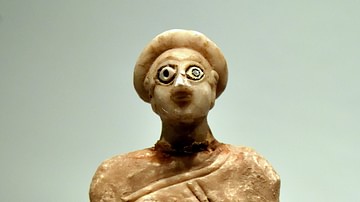
Lost Treasures From Iraq: Revisited & Identified
For how long do we build a household? For how long do we seal a document? For how long do brothers share the inheritance? For how long is there to be jealousy in the land(?)? The Epic of Gilgamesh, chapter 10, Tablet X. I have always...

Image
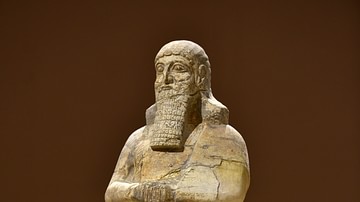
Two Statues of Shalmaneser III at the Iraq Museum
In the centre of this image is the so-called Kurba'il statue of Shalmaneser III (reigned 858-824 BCE), which was found in Fort Shalmaneser in 1961 CE by the British School of Archaeology in Iraq. The statue originally stood in the Temple...
Image
Kurba'il Statue of Shalmaneser III
Kurba'il statue of Shalmaneser III (r. 858-824 BCE), found in Fort Shalmaneser in 1961 by the British School of Archaeology in Iraq. The statue originally stood in the Temple of Adad at the city of Kurba'il, north of modern-day Mosul...

Image
King Sennacherib
This bas-relief is part of a series of reliefs which depict the formation and transport of a colossal winged-bull (Lamassu) for the palace of the Assyrian king Sennacherib. In this relief, the king stands in a rickshaw (a royal chariot which...
Image
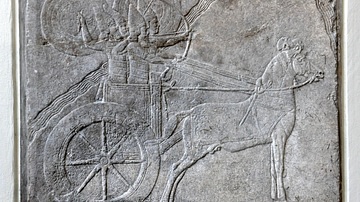
Hamanu campaign on Ashurbanipal's wall relief
This small alabaster wall relief was part of a larger relief that represents the military campaign of the Assyrian king Ashurbanibal against the Elamite city of Hamanu. There is an Assyrian chariot with charioteer and archer, protected from...
Image
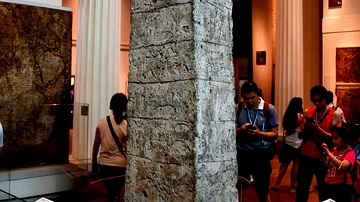
The White Obelisk of Ashurnasirpal I
This limestone stela was excavated in 1853 CE. The incomplete inscription names Ashurnasirpal, probably Ashurnasirpal I (reigned 1049-1031 BCE). He is shown in his chariot fighting (at the top of the stela) and hunting (at the bottom), and...
Image
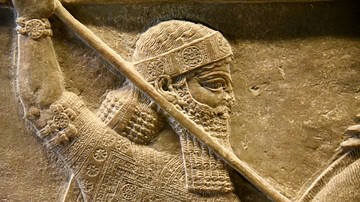
Ashurbanipal II
This is a detail of a large wall relief of the so-called Assyrian lion-hunting scenes. This is the Assyrian King Ashurbanipal II. The King holds a long spear and is about to thrust it into a rearing lion's mouth (not shown here). Note the...

Image
Fleeing Phoenician Queen
This gypsum fragment shows a Phoenician queen holding a baby, fleeing in a boat from the invading Assyrian army. It was once part of limestone relief at the Throne room I of Sennacherib's palace at Nineveh. From the South-West Palace, Nineveh...
