
Search
Did you mean: Solon?
Remove Ads
Advertisement
Search Results
Image
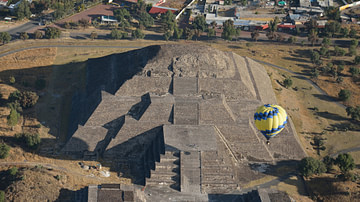
Temple of the Moon, Teotihuacan
The Temple of the Moon at Teotihuacan, Mexico, c. 150 CE.
Image
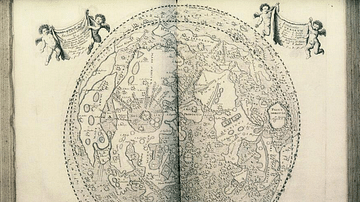
Hevelius' Map of the Moon
A map of the Moon's surface drawn in 1647 by Johannes Hevelius (1611-1687), the Polish astronomer. (Bodleian Library, Oxford)

Image
The Moon
The full Moon.

Image
Half Moon Battery, Edinburgh Castle
The Half Moon Battery of Edinburgh Castle, Scotland. 16-17th century.
Image
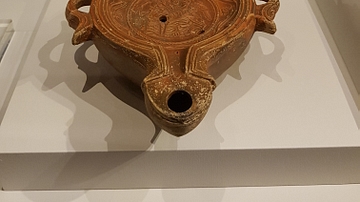
Lamp with Crescent Moon Handle, Pompeii
A ceramic lamp which features an image of the Egyptian god Zeus-Ammon above an eagle on the handle. Pompeii, 1st century CE. Soprintendenza Archeologica di Pompei, (National Maritime Museum, Sydney Australia...

Video
Greek Goddess Artemis: Goddess of the Hunt and the Moon in Greek Mythology
The Greek goddess Artemis was the goddess of the hunt, wild nature and the moon in Greek mythology. She was the daughter of Leto and Zeus, and the twin sister to Apollo, the god of...

Article
The Athenian Calendar
The term “Athenian Calendar” (also called the “Attic Calendar”) has become somewhat of a misnomer, since Ancient Athenians never really used just one method to reckon the passage of time. Athenians, especially from the 3rd...

Definition
Nanna - Mesopotamian God of the Moon and Wisdom
Nanna (also known as Nannar, Nanna-Suen, Sin, Asimbabbar, Namrasit, Inbu) is the Mesopotamian god of the moon and wisdom. He is one of the oldest gods in the Mesopotamian pantheon and is first mentioned...

Definition
Aristarchus of Samos
Aristarchus of Samos (l. c. 310 - c. 230 BCE) was a Greek astronomer who first proposed a heliocentric model of the universe in which the sun, not the earth, was at the center. Although his theory was noted by other thinkers...

Article
The Mayan Pantheon: The Many Gods of the Maya
The pantheon of the Maya is a vast collection of deities worshipped throughout the regions of Yucatan, Quintana Roo, Campeche, Tabasco, and Chiapas in Mexico and southward through Guatemala, Belize, El...
