
Search
Remove Ads
Advertisement
Search Results

Definition
Nazi-Soviet Pact
The Nazi-Soviet Pact, also called the Molotov-Ribbentrop Pact after the respective foreign ministers of the USSR and Germany, was a non-aggression agreement signed in August 1939. The pact allowed the leader of Nazi Germany Adolf Hitler (1889-1945...

Definition
Kellogg-Briand Pact - When 63 States Signed Up for Peace
The Kellogg-Briand Pact was an agreement signed in August 1928 by 63 countries, which all promised, after the horrors of the First World War (1914-18), to regard war as an illegal instrument of national policy. Unfortunately, this sentiment...

Definition
Locarno Pact - The Treaty that Won the Nobel Peace Prize
The Locarno Pact, actually a group of seven treaties (hence its other name: the Locarno Treaties), was signed on 1 December 1925 with the aim that peace continued in Europe despite the German government's disapproval of the Treaty of Versailles...
Image
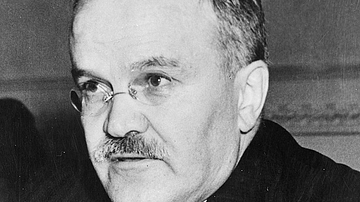
Vyacheslav Molotov
A 1945 photograph of Vyacheslav Molotov (1890-1986), the People’s Commissar of Foreign Affairs for the USSR and negotiator of the Nazi-Soviet Pact of 1939. (Netherlands National Archives)
Image
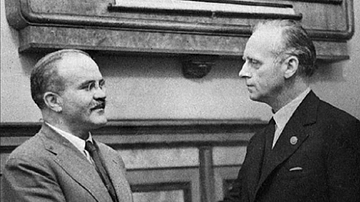
Molotov & Ribbentrop, 1939
A 1939 photograph of Vyacheslav Molotov (1890-1986), the People’s Commissar of Foreign Affairs for the USSR, and Joachim von Ribbentrop (1893-1946), German foreign minister, during negotiations of the Nazi-Soviet Pact.
Image
Nazi-Soviet Pact Cartoon
A cartoon drawn by David Low on the subject of the August 1939 Nazi-Soviet Pact, a non-aggression aggreement between Adolf Hilter (1889-1945), leader of Nazi Germany, and Joseph Stalin (1878-1953), leader of the USSR. Both dictators had spent...
Image
Announcement of the Kellogg-Briand Pact
A photograph of the announcement of the Kellogg-Briand Pact of 1928, an international attempt to ensure future world peace. Speaking is Aristide Briand (1862-1932), the French statesman, while immediately on the right is Frank B. Kellogg...

Image
Neo-Assyrian Political Pact Stele, Al-Anbar
Only this fragment of a large stele has survived. On the surface, the Assyrian and Babylonian kings were carved in relief. The cuneiform inscription narrates a political treaty between them. The faces of the kings were deliberately vandalized...
Image
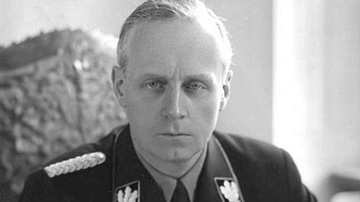
Joachim von Ribbentrop
A 1938 photograph of Joachim von Ribbentrop (1893-1946), Nazi German foreign minister, who negotiated the Nazi-Soviet Pact of 1939. (German Federal Archives)

Article
The Invasion of Poland in 1939
The leader of Nazi Germany Adolf Hitler (1889-1945) ordered the invasion of Poland on 1 September 1939. Hitler's refusal to withdraw brought a declaration of war from Britain and France on 3 September, and so began the Second World War (1939-45...
