
Search
Did you mean: Inca Religion?
Remove Ads
Advertisement
Search Results

Definition
Nefertiti
Nefertiti (c. 1370 - c. 1336 BCE) was the wife of the pharaoh Akhenaten of the 18th Dynasty of Egypt. Her name means, `the beautiful one has come' and, because of the world-famous bust created by the sculptor Thutmose (discovered in...

Definition
Shapur II
Shapur II (r. 309-379 CE, also Sapur II) was the tenth monarch of the Sassanian Empire (224-651 CE) and among the most successful. Under his reign – which lasted his entire life – the Avesta (Zoroastrian scripture) was committed to...

Definition
William the Silent
William the Silent (l. 1533-1584, also known as William of Orange) was the leader of the Dutch Revolt (the Eighty Years' War) in the Netherlands; first politically (between 1559-1568) then militarily (between 1568-1584). He...

Definition
David Hume
David Hume (1711-1776) was a Scottish philosopher, writer, historian, and important figure in the Enlightenment. Hume presented a positive view of human nature but a sceptical view of religion's usefulness. His Treatise of Human Nature...

Definition
Mystery Cults
Mystery cults, or mystery religions, were ancient religious associations characterized by secrecy and initiation rites. They typically surrounded one primary deity, but some mystery cults venerated multiple deities in their rites...

Definition
Ancient Armenia
Ancient Armenia, located in the south Caucasus area of Eurasia, was settled in the Neolithic era but its first recorded state proper was the kingdom of Urartu from the 9th century BCE. Incorporated into the Persian Empire of Cyrus...

Definition
Inca Civilization
The Inca civilization flourished in ancient Peru between c. 1400 and 1533 CE. The Inca Empire eventually extended across western South America from Quito in the north to Santiago in the south. It was the largest empire ever seen...
Article
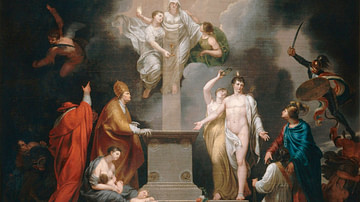
Napoleonic Concordat of 1801 & Religious Pluralism
The Napoleonic Concordat of 1801 defined France's relationship with the Catholic Church for over 100 years. The Organic Articles were added in 1802 and provided state recognition of the Reformed and...

Definition
Baal
Baal (also given as Ba'al) is a Canaanite-Phoenician god of fertility and weather, specifically rainstorms. The name was also used as a title, however, meaning "Lord" and was applied to a number of different deities throughout the ancient...

Article
Twelve Gods of Persian Mythology
Ancient Persian Mythology is the term now referencing ancient Iranian religion prior to the rise of Zoroastrianism between c. 1500-1000 BCE. This was a polytheistic faith with a pantheon led by the supreme god Ahura...
