
Search
Remove Ads
Advertisement
Search Results

Article
Pirate Weapons in the Golden Age of Piracy
Pirates in the so-called Golden Age of Piracy (1690-1740) used all manner of weapons to attack ships and relieve them of their precious cargoes. Heavy cannons, muskets, pistols, cutlasses, and grenades were just some of the weapons pirates...

Article
Treasure & Booty in the Golden Age of Piracy
During the Golden Age of Piracy (1690-1730), pirates were first and foremost after gold, silver, and jewels, but if these could not be grabbed, then a ship’s cargo would be taken for resale at a pirate haven. Shared amongst the crew, the...

Article
Archaeological Excavations at Tel Kabri
Tel Kabri is an archaeological site in northwestern Israel that is best known as the location of one of the largest palaces in Canaan in the Middle Bronze Age or "MB" (ca. 2,000–1,500 BCE). Although Tel Kabri reached the height of its power...

Definition
Canaan
Canaan was the name of a large and prosperous ancient country (at times independent, at others a tributary to Egypt) located in the Levant region of present-day Lebanon, Syria, Jordan, and Israel. It was also known as Phoenicia. The origin...

Article
Baroque, Age of Contrasts - Exhibition Interview Schweizerisches Landesmuseum
The Baroque era, which lasted from roughly 1580 and 1780, was a time of enormous contrasts: Opulence and innovation, on the one hand; death and crises, on the other. Ongoing religious wars and the opening of global trade networks led to mass...

Article
Etruscan Bronze Mirrors
The Etruscan civilization flourished in central Italy between the 8th and 3rd century BCE and produced distinctive art in the form of decorated pottery, figure sculpture, wall paintings, and the focus of this article, engraved bronze mirrors...

Image
Bronze Age Anatolia
A map of Bronze Age Anatolia. Indicated in the northeast is the Hayasa-Azzi confederation, an indigenous Bronze Age tribal confederation which flourished on the plateau of ancient Armenia and Turkey between c. 1500 and c. 1200 BCE.

Image
Bronze Age Burial Tomb at Lchashen
When Lake Sevan's water dropped due to hydroelectric production in 1950, countless graves and other ancient artifacts were uncovered in Lchashen, Armenia. Over the decades, 800 graves were discovered the majority of which were made from stone...

Image
Stela of Hernán Pérez VI from Bronze Age Iberia
This granite stela dates from the Early or Middle Bronze Age. It was discovered in Cáceres, Spain. (Museo Arqueológico Nacional, Madrid)
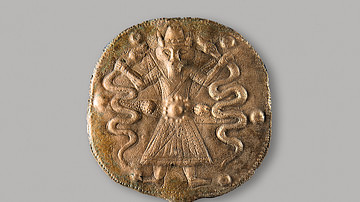
Image
Bronze Hairpin Depicting 'Master of Animals' from Iron Age Zagros
Bronze Hairpin Depicting 'Master of Animals', found in Luristan (central Zagros), c. 950 to c. 650 BCE. National Museum of Iran, Tehran, acc. no. 1459. Photo by Neda Tehrani (Baloot Noghrei) Long bronze hairpins crowned with a large disk...
