
Search
Remove Ads
Advertisement
Search Results

Definition
Children's Crusade
The so-called Children's Crusade of 1212 CE, was a popular, double religious movement led by a French youth, Stephen of Cloyes, and a German boy, Nicholas of Cologne, who gathered two armies of perhaps 20,000 children, adolescents...

Definition
Zorvanism
Zorvanism (also given as Zuvanism, Zurvanism) was a sect of the Persian religion Zoroastrianism which emerged in the late Achaemenid Empire (c. 550-330 BCE) and flourished during the Sassanian Empire (224-651 CE). It is often referenced...

Definition
Jerash
Jerash (aka Gerasa, Gerash or Gerasha) is the capital and the largest city of the Jerash Governorate in Jordan, but in ancient times it was one of the wealthiest and most cosmopolitan cities in the ancient Near East. Settled by humans...

Image
Map of Ibn Battuta’s Travels, 1325-1354 - Medieval Travel, Scholarship & Connectivity in Afro-Eurasia
Ibn Battuta ((Abū Abd Allāh Muḥammad ibn Abd Allāh Al-Lawātī, 1304–c. 1368 CE) was a traveler, jurist, and scholar from Tangier whose journeys across Afro-Eurasia...

Image
Map of the First Three Crusades & the 12th-Century Outremer
These maps illustrate the trajectory of the early Crusades (1096–1192), a series of military campaigns launched by the medieval Latin Church with the declared goal of reclaiming the Holy Land—centered...
Article
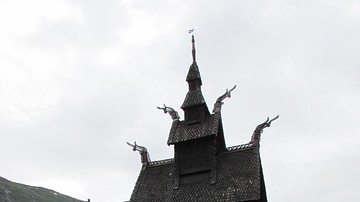
Stave Churches: Norway’s National Treasures
Stave churches are the most famous medieval buildings in Norway and are admired for their unique architecture and beautiful decorations. They are named after the staves or masts that hold up the main structure...

Article
Gothic Cathedrals: Architecture & Divine Light
Gothic cathedrals are some of the most recognizable and magnificent architectural feats. With soaring towers and softly filtered light streaming through stained glass windows, everything about the Gothic...

Article
Why Did Hitler Hate Jewish People?
The leader of Nazi Germany Adolf Hitler (1889-1945) identified Jewish people as enemies of the state, presenting them through relentless propaganda as responsible for Germany's economic and cultural decline. Basing...

Article
Unam Sanctam: Spiritual Authority & the Medieval Church
The Unam Sanctam (1302) was a papal bull issued by Pope Boniface VIII (served 1294-1303) requiring the complete submission of all people, including kings, to the authority and dictates of the pope...

Article
Siege Warfare in Medieval Europe
Siege tactics were a crucial part of medieval warfare, especially from the 11th century CE when castles became more widespread in Europe and sieges outnumbered pitched battles. Castles and fortified cities offered...
