
Search
Remove Ads
Advertisement
Search Results
Image
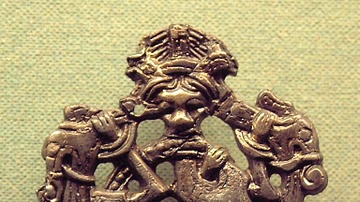
Viking Age Pin In Borre Style
Viking Age bronze clothing pin (fibula) found in the Viking settlement of Hedeby, heavily decorated in the so-called Borre style (c. 850-late 10th century CE).

Image
Warrior Stela from Bronze Age Iberia
This stela is from Solana de Cabañas (Cabañas del Castillo, Cáceres), Spain and dates from the Late Bronze Age. It is made of slate, and it was unearthed in the late 19th century CE. This was the first specimen...

Image
Bronze Age Burial Tomb at Lchashen
When Lake Sevan's water dropped due to hydroelectric production in 1950, countless graves and other ancient artifacts were uncovered in Lchashen, Armenia. Over the decades, 800 graves were discovered the majority...
Image
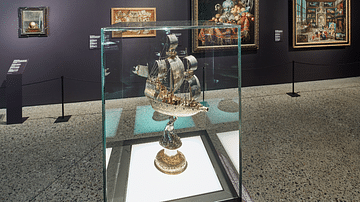
Baroque, Age of Contrasts, Swiss National Museum
A photograph showing part of the exhibition space of the 2022-23 exhibition Baroque, Age of Contrasts in the Swiss National Museum, Zürich.
©Swiss National Museum (used with permission)
Image
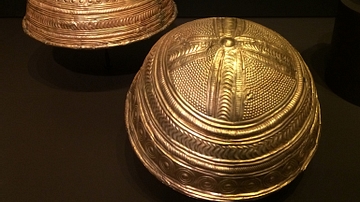
Late Bronze Age Iberian Bowls
These bowls are from the Late Bronze Age settlement of Axtroki (Bolibar, Excoriatza, Guipúzcoa), Spain and are made from pure gold. When they were found, one bowl was inside the other. It has recently been suggested...
Image
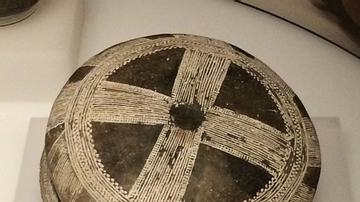
Early Bronze Age Bell Beakers from Iberia
These clay bell beakers come from the Early Bronze Age necropolis of Ciempozuelos (Cuesta de la Reina, Madrid), Spain and they were found during excavations conducted in the late 19th century CE. (Ciempozuelos...
Image
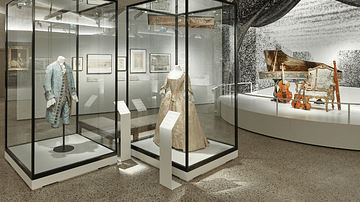
Baroque, Age of Contrasts Exhibition in Zürich
A photograph showing a section of the 2022-23 exhibition Baroque, Age of Contrasts in the Swiss National Museum, Zürich.
©Swiss National Museum (used with permission)

Image
Bronze Age Stilt House Interior
Interior of a reconstructed Bronze Age stilt house.
Museum zu Allerheiligen, Schaffhausen, Germany.
Image
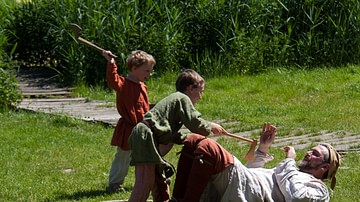
Viking Age Reenactors
Reenactors bring childhood in the Viking Age to life, 2012.
Archeon, Alphen aan den Rijn.

Image
Stela of Hernán Pérez VI from Bronze Age Iberia
This granite stela dates from the Early or Middle Bronze Age. It was discovered in Cáceres, Spain. (Museo Arqueológico Nacional, Madrid)
