
Search
Remove Ads
Advertisement
Search Results

Article
Artillery in Medieval Europe
Artillery weapons in medieval Europe included the mounted crossbow (ballista) and single-arm torsion catapult (mangonel), both similar to ancient Roman machines. As armies battled further afield such as in the Byzantine...

Article
The Layout of a Medieval Abbey
Abbeys were a striking feature of medieval urban and rural landscapes. Their layout and architecture reflected their purpose as cut-off monastic retreats which, conversely, also served and inspired their local communities...

Article
How to Become a Medieval Knight
In medieval society a knight enjoyed a position of high status and often wealth, they were feared on the battlefield and known for their chivalry off it, but it took a long time and a lot of training to get there...

Article
Fashion & Dress in Ancient Mesopotamia - From Basic to Accessorized in the Ancient World
Fashion and dress in Mesopotamia – clothing, footwear, and accessories – were not only functional but defined one's social status and developed from a simple loincloth in...
Image
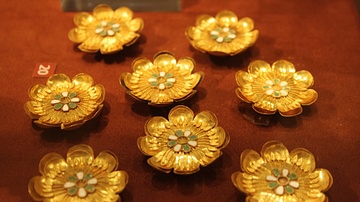
Gold Rosettes for Ancient Greek Clothing
Gold and enamel rosettes used to decorate ancient Greek clothing. 4th century BCE.(National Archaeological Museum, Athens)

Video
Clothing and Fashion in Ancient Rome
In this video, we explore the fascinating world of clothing in ancient Rome. From the basic tunica to the formal toga, we'll take a look at what people wore and how they used clothing to indicate social status...

Article
Trade in Medieval Europe
Trade and commerce in the medieval world developed to such an extent that even relatively small communities had access to weekly markets and, perhaps a day's travel away, larger but less frequent fairs, where the full range...

Image
Anglo-Saxon Clothing, 6-9th century CE
An illustration of the typical clothing worn by Anglo-Saxons in medieval England, c. 500 - c. 1000 CE. ('Costumes of all Nations', 1882 CE)
Article
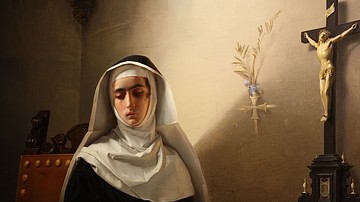
The Daily Life of Medieval Nuns
Monasteries were an ever-present feature of the Medieval landscape and perhaps more than half were devoted solely to women. The rules and lifestyle within a nunnery were very similar to those in a male monastery. Nuns...

Article
The Weapons of an English Medieval Knight
The weapons of an English medieval knight in combat included the long sword, wooden lance with an iron tip, metal-headed mace, battle-axe, and dagger. Trained since childhood and practised at tournaments, the...
