
Search
Remove Ads
Advertisement
Search Results

Article
Peasant Life in a Medieval Manor - The Family of Bodo, Carolingian Farmers
Bodo was a early 9th-century Frankish farmer. He and his family hailed from a manor owned by the monastery of St.-Germain-des-Prés near Paris and worked as its tenants. He ploughed...

Article
Medieval Cures for the Black Death
The Black Death is the 19th-century CE term for the plague epidemic that ravaged Europe between 1347-1352 CE, killing an estimated 30 million people there and many more worldwide as it reached pandemic proportions...
Article
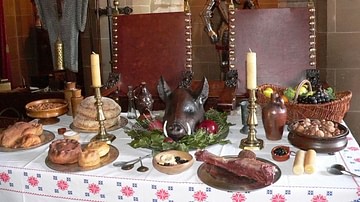
Food in an English Medieval Castle
If one was looking to enjoy a fine meal in the medieval world then the best place to find a handsomely laid dinner table was in the local castle. There, in the magnificent Great Hall, feasts were regularly served...

Article
Interview: Medieval Christian Art in the Levant
Medievalists retain misconceptions and myths about Oriental Christians. Indeed, the fact that the Middle East is the birthplace of Christianity is an afterthought for many. During the Middle Ages, Christians...

Article
Medieval Climate Anomaly in the Americas
To climatologists, the period of seven to twelve centuries ago was known as a "Climate Anomaly" or a "Warm Period" (800-1300 CE). To archaeologists, it was a time of great change, a period when cultural patterns...

Article
Siege Warfare in Medieval Europe
Siege tactics were a crucial part of medieval warfare, especially from the 11th century CE when castles became more widespread in Europe and sieges outnumbered pitched battles. Castles and fortified cities offered...

Article
A Medieval Christmas
Christmas was one of the highlights of the medieval calendar, not only for the rich but also for the peasantry. For the longest holiday of the year, typically the full twelve days of Christmas, people stopped work, homes were...

Article
Toilets in a Medieval Castle
The medieval toilet or latrine, then called a privy or garderobe, was a primitive affair, but in a castle, one might find a little more comfort and certainly a great deal more design effort than had been invested elsewhere...

Article
Visiting The Ruins of Lisbon’s Ancient and Medieval Past
Visiting the vibrant and colorful city of Lisbon, on the banks of the river Tagus and the edge of the Atlantic Ocean, what is most showcased is one episode of the city's and country's glorious past...

Article
The Household Staff in an English Medieval Castle
An English medieval castle, if a large one, could have a household staff of at least 50 people, which included all manner of specialised and skilled workers such as cooks, grooms, carpenters, masons...
