
Search
Remove Ads
Advertisement
Search Results

Image
Baths of Antoninus, Carthage
Ruins of the Baths of Antoninus in Carthage, photograph by Carole Raddato, Tunisia, 12 February, 2023. The Baths of Antoninus in Carthage (modern-day Tunis) are a huge Roman bath complex built between 145 and 162 CE, primarily during the...
Image
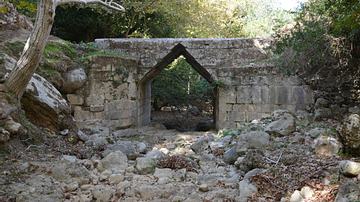
Hellenistic Bridge at Eleutherna, Crete
The Eleutherna Bridge on Crete is a well-preserved Hellenistic corbel arch bridge with a single span of 3.95 m. It was built with large limestone blocks in dry masonry around 330 - 367 BCE when a major construction project took place at Eleutherna...

Image
Maya Ruins of San Gervasio on Cozumel
This photograph shows some Maya ruins from the San Gervasio archaeological site, which is located on the island of Cozumel in Mexico. In the center, one sees the "Niches" structure, which was once composed of miniature shrines that were built...

Image
Atrium of Villa San Marco in Stabiae
View of the four-colonnaded atrium of the Villa San Marco in Stabiae, Italy (1st century BCE). The tetrastyle atrium was entered through a small colonnaded and frescoed portico furnished with masonry seats for waiting visitors. Looking across...
Image
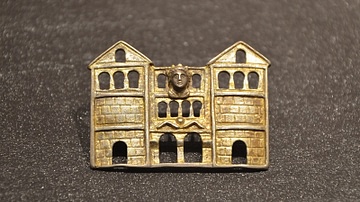
Roman Gilt Silver Fibula
Roman gilt silver fibula in the form of a three-story tripartite gate of rusticated masonry, with a central double-arched entrance flanked by two towers and a draped bust of Sol at the top story, c. 3rd century to early 4th century CE. Römisch-Germanisches...
Image
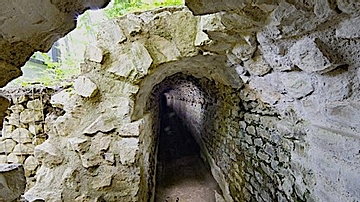
Water Conduit at Augusta Raurica
Via a subterranean masonry, an ancient Roman water conduit brought Augusta Raurica water from the River Ergolz. Just outside the town wall the conduit merged into an aqueduct, which in turn funneled the water into a water tower where it was...
Image
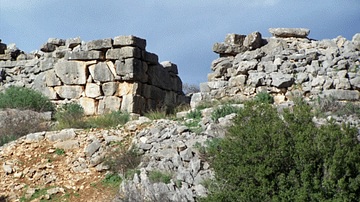
The South Gate at Gla
Ashlar masonry of the south gate at the Mycenaean site Gla, Greece, built c. 13th century BCE (Mycenaean LHIII).

Image
Forum of Thuburbo Majus
Ruins of the forum in Thuburbo Majus, photograph by Carole Raddato, El Fahs, Tunisia, 18 February, 2023. The well-preserved Forum of Thuburbo Majus in modern-day Tunisia was built between 161 and 192 CE. It was a vast square covering an...
Image
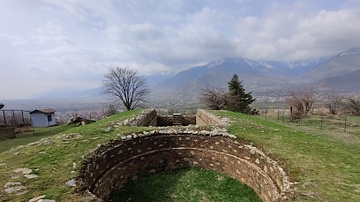
Round Apsidal Shrine, Harwan Monastery
An apsidal shrine made in diaper pebble masonry on the second terrace of the complex. From the Harwan Monastery in Kashmir, India.

Video
The History of Egypt - The Hyksos (Part 2)
The Hyksos ruled Egypt from 1730 - 1550 B.C.E. The remains of their structures, characterized by the "cyclopean" masonry techniques, can be found throughout the Mediterranean regions that they controlled.
