
Search
Remove Ads
Advertisement
Search Results

Definition
Alexander Hamilton
Alexander Hamilton (1755/57-1804) was a lawyer and politician, often recognized as a Founding Father of the United States. He served as George Washington's aide-de-camp during the American Revolution, before going on to become...
Definition
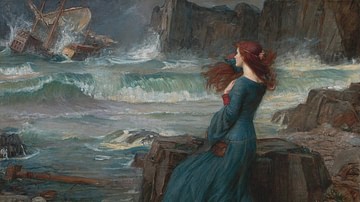
The Tempest - Shakespeare's Magical Tragicomedy
The Tempest is a play by William Shakespeare (c. 1564-1616), written in 1610 or 1611, and first performed for the court of James I of England (r. 1603-1625) on 2 November 1611. Believed to be the last play...

Definition
Sulla
Lucius Cornelius Sulla (138-78 BCE) was a ruthless military commander, who first distinguished himself in the Numidian War under the command of Gaius Marius. His relationship with Marius soured during the conflicts that would follow and...

Article
Hesiod on the Birth of the Gods
The Greek poet Hesiod (c. 700 BCE) is most famous for his works Theogony and Works and Days. In this passage from Theogony, Hesiod relates the birth of the gods from cosmic Chaos and follows the lineage through the...

Article
The Dragon in Ancient China
Dragons appear in the mythology of many ancient cultures but nowhere else in the world was the creature quite so revered as in China. There, in marked contrast to other world mythologies, the dragon was almost always...

Article
The Temple of the Emerald Buddha
A small carved figurine sits high on a grand multi-tiered pedestal in a magnificent wat (temple) in Bangkok, Thailand. It has been sitting there since 1784 CE and was originally thought to be made of emerald. Hundreds...

Article
The Hindenburg Disaster - End of the Transatlantic Airships
The Hindenburg disaster occurred on 6 May 1937 when the German Zeppelin airship LZ 129 Hindenburg attempted to land at Lakehurst, New Jersey, but burst into flames. The airship's gas cells were...

Article
Etruscan Bronze Sculpture
The Etruscans produced bronze goods going back to the Villanovan period (1100-750 BCE) and used the material for all manner of objects, but it is their figure sculptures which have become some of the star attractions in...

Article
Religion in the Mongol Empire
The Mongol Empire (1206-1368 CE) covered Asia from the Black Sea to the Korean peninsula and so naturally included all manner of religions within its borders, but the Mongols themselves had their own particular religious...

Article
The Ancient Celtic Pantheon
The ancient Celtic pantheon consisted of over 400 gods and goddesses who represented everything from rivers to warfare. With perhaps the exception of Lugh, the Celtic gods were not universally worshipped across Iron Age...
