
Search
Remove Ads
Advertisement
Search Results
Image
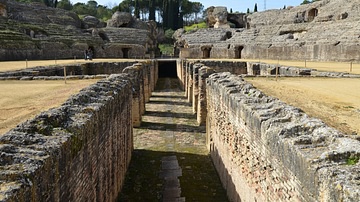
Roman Amphitheatre of Italica (Spain)
The Roman amphitheatre of Italica (located in modern-day Santiponce, 9 kilometres north of Seville in Spain) was one of the largest in the Empire, measuring 160 by 137 metres (525 by 450 feet). It was built during...
Image
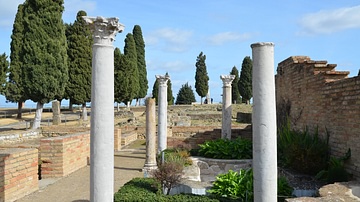
House of the Birds, Italica (Spain)
The House of the Birds is a large residence in Italica (an archaeological site located in modern-day Santiponce, 9 kilometres (5.5 miles) north of Seville in Spain) endowed with a good quantity of mosaics of high...
Image
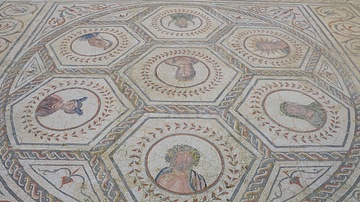
Mosaic with Busts of the Planetary Deities, Italica (Spain)
Mosaic in the House of the Planetarium in Italica (an archaeological site located in modern-day Santiponce, 9 kilometres (5.5 miles) north of Seville in Spain) with busts of the planetary deities...

Image
Legio X Fretensis Inscription on a Sword Belt
Sword belt decoration with the inscription LG X FR FEL: Legio X Fretensis Felix (the fortunate), early 3rd century CE. Israel Museum, Jerusalem.

Image
Dedication to Hadrian by Legio X Fretensis
Inscription set up by the soldiers of Legio X Fretensis to coincide with the official visit of Hadrian to Aelia Capitolina in 130 CE. Israel Museum, Jerusalem. "To the Imperator Caesar Traianus Hadrianus...
Image
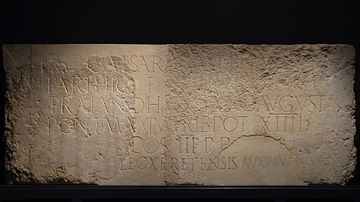
Dedication to Hadrian by Legio X Fretensis
Inscription set up by the soldiers of Legio X Fretensis to coincide with the official visit of Hadrian to Aelia Capitolina in 130 CE. Israel Museum, Jerusalem. ”To the Imperator Caesar Traianus Hadrianus...
Image
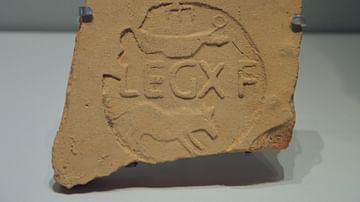
Stamp of Legio X Fretensis
Tile fragment with a stamp of Legio X Fretensis, "LG X F", and its symbol, a wild boar and a battleship. Found in Jerusalem, 1st-2nd century CE. Israel Museum, Jerusalem.

Image
Eighth Cohort of Legio X Fretensis
Inscription of the eighth cohort of Legio X Fretensis. From Jerusalem or Samaria, 1st-2nd century CE. Israel Museum, Jerusalem.

Article
Top 5 Roman Sites in Southern Spain
Almost 700 years of continuous Roman occupation have left impressive traces in the Spanish landscape. Spain was then known as 'Hispania' and is now a fascinating location for the archaeological traveller. The...
Article
Legions of the Dacian Wars
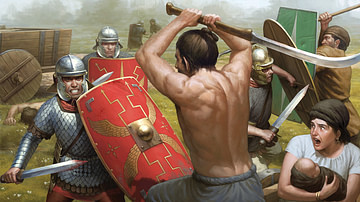
The Dacian Wars started after Decebalus (r. c. 87-106 CE) raided the Roman province of Moesia in 85 CE. Emperor Domitian's (r. 81-96 CE) Dacian campaigns in 86-87 CE reached an uneasy peace, but the conflict was renewed...
