
Search
Remove Ads
Advertisement
Search Results
Definition
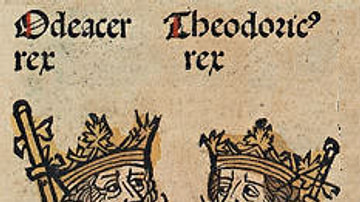
Theodoric the Great
Theodoric the Great (l. c. 454-526 CE, r. 493-526 CE, also known as Flavius Theodoricus) was the king of the Ostrogoths who, at the encouragement and direction of the Roman emperor Zeno, invaded Italy, deposed King Odoacer...

Definition
Charlemagne
Charlemagne (Charles the Great, also known as Charles I, l. 742-814) was King of the Franks (r. 768-814), King of the Franks and Lombards (r. 774-814), and Holy Roman Emperor (r. 800-814). He is among the best-known and most influential...
Definition
Tacitus
Publius Cornelius Tacitus (l. c. 56 - c. 118 CE) was a Roman historian, active throughout the reign of Trajan (r. 98-117 CE) and the early years of Hadrian (r. 117-138 CE). His best-known works are Histories and Annals, which cover the...

Definition
Valerian
Valerian ruled as emperor of the Roman Empire from 253 CE until his capture in 260 CE. In 253 CE an elderly Roman military commander and experienced former senator was proclaimed emperor by his troops - a very common occurrence at the...

Definition
Pachacuti Inca Yupanqui - Founder of the Inca Empire
Pachacuti Inca Yupanqui (often simply Pachacuti or Pachacutec) was the 9th Inca ruler (r. 1438 - 1471 CE) who founded their empire with conquests in the Cuzco Valley and beyond. Pachacuti is also credited...

Definition
Postumus
Postumus was Roman emperor from 260 to 269 CE. Marcus Cassianus Latinius Postumus was a trusted military commander of Emperor Gallienus (253-268 CE) and governor or Germania Superior and Inferior (Upper and Lower Germany). After the...
Definition
Fritigern
Fritigern (also Fritigernus, died c. 380 CE) was a Visigothic king best known as the victor of the decisive Battle of Adrianople in 378 CE, which decimated the Roman army and haunted Roman military commanders for decades afterwards...

Definition
Europe
Europe is a continent forming the westernmost part of the land mass of Eurasia and comprised of 49 sovereign states. Its name may come from the Greek myth of Europa, but human habitation of the region predates that tale, going back over...
Definition
Inca Warfare
The warfare of the Inca civilization was characterised by a high degree of mobility, large-scale engagements of hand-to-hand combat, and the establishment of a network of fortresses to protect an empire of over 10 million subjects...

Definition
Roman Art
The Romans controlled such a vast empire for so long a period that a summary of the art produced in that time can only be a brief and selective one. Perhaps, though, the greatest points of distinction for Roman art are its very diversity...
