
Search
Remove Ads
Advertisement
Search Results

Image
Map of the Mughal Empire at Its Greatest Extent, c. 1707 - Expansion, provinces, and contested frontiers
The Mughal Empire (1526–1857) emerged from the military and political ambitions of Ẓahīr al-Dīn Muḥammad Babur (reign 1526–1530), a Timurid prince from Central...

Video
History of the Aztec Civilization, a Mesoamerican Empire
The Aztec civilisation spanned from around 1300 CE until 1521, and at its greatest extent, the empire covered most of Northern Mesoamerica. Although we refer to these peoples as ‘Aztecs,’ that is...

Video
The Flavian Dynasty of the Roman Empire
The Flavian Emperors were a dynasty of Roman emperors who ruled from 69 to 96 CE. They consisted of three emperors: Vespasian, Titus, and Domitian. - Vespasian (ruled 69-79 CE) was a skilled military commander...

Image
Map of the Italian Empire in 1942 - The Spatial and Political Dimensions of Italian Imperialism
The Italian Colonial Empire emerged during the period of New Imperialism (late 19th–early 20th centuries) as the recently unified Kingdom of Italy sought to secure...

Image
Map of the Russian Empire in 1914 - From Muscovy to World War I, 1533–1914
By 1914, the Russian Empire was one of the largest contiguous empires in history, stretching from Eastern Europe across Siberia to the Pacific. Its expansion began under the rulers...

Image
Map of the Provinces of the Roman Empire under Augustus
This map illustrates the expansion of the Roman Republic during the military campaigns and conquests of Julius Caesar (100–44 BCE), and its transformation into an empire under the reign of Caesar...

Image
Map of the Rise and Fall of the Mexica (Aztec) Empire - Alliance, Expansion, and Tribute Power in Mesoamerica
The Mexica (commonly referred to as the Aztecs) emerged as a dominant power in central Mexico during the Late Postclassic period, culminating in the formation...

Definition
Ashurbanipal
Ashurbanipal (r. 668-627 BCE, also known as Assurbanipal) was the last of the great kings of Assyria. His name means "the god Ashur is creator of an heir" and he was the son of King Esarhaddon of the Neo-Assyrian Empire. In the Hebrew...

Definition
Edward Gibbon
Edward Gibbon (1737-1794) was an English historian most famous for his influential work The History of the Decline and Fall of the Roman Empire, volume one of which was published in 1776, with the final sixth volume coming in 1788...
Definition
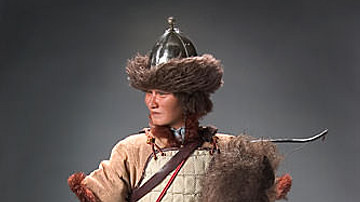
Attila the Hun
Attila the Hun (r. 434-453 CE) was the leader of the ancient nomadic people known as the Huns and ruler of the Hunnic Empire, which he established. His name means "Little Father" and, according to some historians, may not have...
