
Search
Did you mean: Knossos?
Remove Ads
Advertisement
Search Results

Definition
Shulgi of Ur - Greatest King of the Ur III Period
Shulgi of Ur (reign 2094 to circa 2046 BCE) is considered the greatest king of the Ur III period in Mesopotamia (circa 2112 to circa 2004 BCE). His father was Ur-Nammu (reign circa 2112-2094 BCE), who...

Definition
Samos
Samos is a Greek island in the east Aegean, just off the coast of modern-day Turkey. It particularly flourished in the 6th century BCE and was famous in antiquity for its navy, wine, and important sanctuary to Hera. Samos was an active...

Image
Statue of a Greek Youth
This standing Greek youth is nude and his left thigh (the leg is lost) appears to advance forward. The neck and shoulders are smoothly modeled. His hair is plaited and falls behind the head. Many similar statues (or head...

Article
A Praise Poem of Shulgi - A Celebration of an Ancient Famous Run
A Praise Poem of Shulgi (written circa 2020-2000 BCE) is an ancient Sumerian document celebrating the famous run of 200 miles (321.8 km) in one day made by the king Shulgi of Ur (reign 2094...

Image
Greek Chariot Racers
Greek chariot racers from the base of a funerary kouros, later included in the Themistokleian Wall of Athens. 510-500 BCE. (National Archaeological Museum, Athens)

Image
Greek Wrestlers
A relief from a funerary kouros base depicting two Greek wrestlers, one of the sports at such events as the Olympic Games at Olympia. c. 510 BCE. (National Archaeological Museum, Athens)

Image
Greek Wrestling
A detail of a wrestling scene, c. 510 BCE from the base of a funerary kouros. (National Archaeological Museum, Athens)
Image
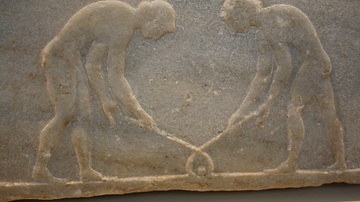
Greek Hockey Players
Greek athletes playing a game similar to modern hockey. From the base of a funerary kouros, later included in the Themistokleian Wall of Athens. 510-500 BCE. (National Archaeological Museum, Athens)

Image
Greek Athletes
Greek athletes. From the base of a funerary kouros, later included in the Themistokleian Wall of Athens. 510-500 BCE. (National Archaeological Museum, Athens)

Definition
Oda Nobunaga
Oda Nobunaga was the foremost military leader of Japan from 1568 to 1582. Nobunaga, along with his two immediate successors, Toyotomi Hideyoshi (1537-1598) and Tokugawa Ieyasu (1543-1616), is credited with unifying medieval Japan...
