
Search
Did you mean: Justinian I?
Search Results

Definition
Tigranocerta
Tigranocerta (Tigranakert) was a city in the southwest of ancient Armenia founded and made capital by Tigranes the Great in 83 BCE. Famous for its riches and fine buildings, as well as its mix of Hellenistic and Persian culture, the city...

Definition
Paros
Paros is an island in the Cyclades group in the central Aegean. It is the third largest island of the Cyclades and its position on important sea routes between mainland Greece and the coast of Asia Minor made it an important centre from the...

Definition
Caesarea (North Africa)
Caesarea was actually the name of three separate cities: one in Palestine, one in Cappadocia (Asia Minor), and one in Mauretania, present-day Algeria. The first city, Caesarea Maritima, was built by Herod around 25 BCE and, like the other...
Definition
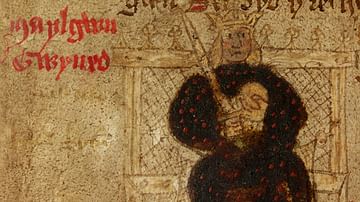
Maglocunus
Maglocunus, known as Maelgwn Gwynedd in Welsh (d. c. 547), was a 6th-century monarch based in Gwynedd, in north-western Wales. Maglocunus' name means "princely hound", and he expanded his influence to become one of the pre-eminent rulers...

Image
Theodora I
Theodora: Detail from the 6th-century mosaic "Empress Theodora and Her Court" in the Basilica of San Vitale in Ravenna.
Image
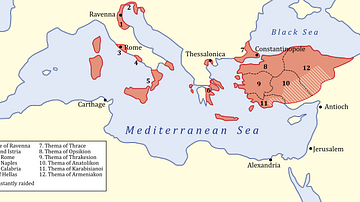
Byzantine Empire, 717 CE
A map of the Byzantine empire and its themes and provinces in 717 CE.
Image
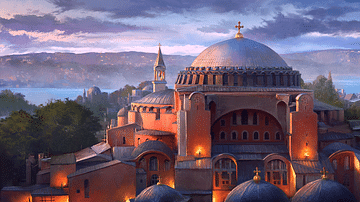
Painting of Hagia Sophia
An artist's depiction of the Hagia Sophia in Constantinople, as it may have appeared in 537 CE. From the game Old World.

Article
Religious Responses to the Black Death
The Black Death of 1347-1352 CE is the most infamous plague outbreak of the medieval world, unprecedented and unequaled until the 1918-1919 CE flu pandemic in the modern age. The cause of the plague was unknown and, in accordance with the...

Article
Women in the Middle Ages
The lives of women in the Middle Ages were determined by the Church and the aristocracy. The medieval Church provided the 'big picture' of the meaning of life and one's place while the aristocracy ensured that everyone stayed in their respective...

Article
Caesar As Dictator: His Impact on the City of Rome
Gaius Julius Caesar (100-44 BCE) first assumed the role of dictator in 49 BCE, however, once he had secured his election as consul for the following year, he resigned after 11 days. After defeating Pompey at the Battle of Pharsalus in 48...
