
Search
Did you mean: Qin Dynasty?
Remove Ads
Advertisement

 This answer was generated by
 Search Results

Definition
Jurchen Jin Dynasty
The Jurchen Jin dynasty (meaning “Golden”) ruled parts of China, Mongolia, and northern Korea from 1115 to 1234 CE. The Jurchen originated from Manchuria, but in conquering the neighbouring Liao empire of the Khitan and parts...
Image
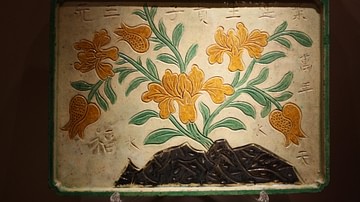
Jin Dynasty Stoneware Tray
A glazed stone tray, 12th century CE, Jin Dynasty. (Museum of Asian Art, Corfu)

Definition
Genghis Khan
Genghis Khan (aka Chinggis Khan) was the founder of the Mongol Empire which he ruled from 1206 until his death in 1227. Born Temujin, he acquired the title of Genghis Khan, likely meaning 'universal ruler’, after unifying the Mongol...

Definition
Song Dynasty
The Song (aka Sung) dynasty ruled China from 960 to 1279 CE with the reign split into two periods: the Northern Song (960-1125 CE) and Southern Song (1125-1279 CE). The Northern Song ruled a largely united China from their capital...

Image
Jurchen Jin Dynasty Vase
A green glazed vase with floral design, Jurchen Jin dynasty, 1115-1234 CE. (British Museum, London)

Definition
Tang Dynasty
The Tang Dynasty (618-907 CE) was one of the greatest in Imperial Chinese history. It was a golden age of reform and cultural advancement which lay the foundation for policies which are still observed in China today. The second emperor...

Article
War of the Eight Princes
The War of the Eight Princes (291-306 CE) is the conflict which weakened and finally ended the Western Jin Dynasty (266-316 CE) in China and resulted in more far-reaching consequences throughout the country. The power of...

Article
The Mandate of Heaven and The Yellow Turban Rebellion
Throughout history, in order for a government to be respected and obeyed, it must possess some form of legitimacy recognized by the governed. Governmental systems have relied on a number of models...

Definition
Ögedei Khan
Ogedei Khan (aka Ogodei) ruled the Mongol Empire from 1229 to 1241. He was the third son of Genghis Khan (r. 1206-1227), the empire's founder. Ogedei's accomplishments included creating a new capital at Karakorum, establishing a system...

Definition
Han Dynasty
The Han Dynasty (202 BCE - 220 CE) was the second dynasty of Imperial China (the era of centralized, dynastic government, 221 BCE - 1912 CE) which established the paradigm for all succeeding dynasties up through 1912 CE. It succeeded...
