
Search
Remove Ads
Advertisement
Search Results

Definition
Roman Senate - Membership, Procedures, & Decline
The Roman Senate functioned as an advisory body to Rome's magistrates and was composed of the city's most experienced public servants and society's elite. Its decisions carried great weight, even if these...

Definition
Sui Dynasty
The Sui Dynasty (581-618 CE) was a brief one with only two reigning emperors but it managed to unify China following the split of the Northern and Southern Dynasties period. As had happened previously in Chinese history, a short-lived...

Definition
Roman Philosophy
Roman philosophy played a significant role in the growth and development of Western thought. While not involved directly in the development of original philosophical thought, Rome made significant contributions in two ways: by...
Definition
Enryakuji
The Enryakuji is a Buddhist monastic complex on the sacred Mt. Hiei, near Kyoto, Japan. The site was selected by the monk Saicho to become the headquarters of the Tendai sect, which he founded in Japan in the early 9th century CE...

Article
Interview: Lisbon's Museu do Oriente - Asian-European Exchanges in Art
Situated close to Lisbon's revitalized waterfront, the Museu do Oriente offers one of Europe's most distinctive windows onto the long history of encounters between Portugal and Asia...
Article
The Ryukyu Castles of Okinawa
The medieval Ryukyu castles on the island of Okinawa, Japan are impressive testimony to the kingdom's power and wealth from the 12th to 16th century. Notable castles include Shuri Castle, the royal residence, and four...

Article
The English and Dutch East India Companies' Invasions of India
In the early 17th century, the Dutch and English East India Companies turned their eyes towards India, as part of their grand schemes to develop extensive trade networks across the Indian and...

Image
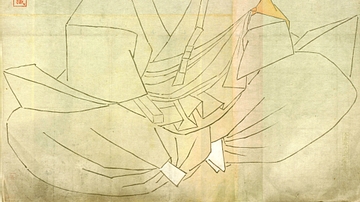
Emperor Toba
An illustration depicting Japanese Emperor Toba (r. 1107-1123 CE)
Image
Emperor Shirakawa
An illustration depicting Japanese Emperor Shirakawa (r. 1073-1086 CE).

Image
Emperor Kammu
A 16th century CE portrait on silk of Japanese Emperor Kammu (r. 781 to 806 CE) who is most noted for relocating the capital to Heiankyo (Kyoto) in 784 CE. (Enryaku-ji Monastery, near Kyoto, Japan)
