
Search
Did you mean: Hades?
Remove Ads
Advertisement
Search Results

Image
Han Dynasty Jade Dragon
A carved jade dragon. Han dynasty, 2nd-1st century BCE.
The British Museum, London.

Image
Han Jade Burial Suit
A funerary garment from the Han dynasty (2nd century BCE - 2 century CE). Made from hundreds of small rectangles of jade stitched together using gold and silver wire, they were used to completely encase the body of deceased...
Image
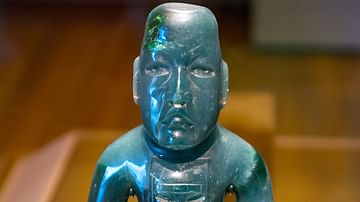
Olmec Jade Figurine
A polished jade figurine from the Olmec civilization of Mesoamerica. The larger figure holds a deity, probably a representation of a rain god. (Brooklyn Museum, New York)
Image
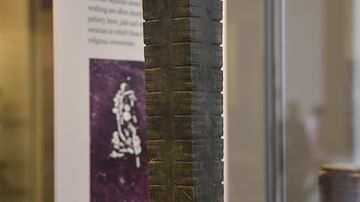
Liangzhu Jade Cong
Cong is the name given to a type of jade of unknown purpose, found in burials of the Neolithic period in Southeast China. The Cong has a square cross-section with a cylindrical hole. Congs are often decorated at the corners...

Image
Maya Jade Plaque
A Maya jade plaque from Nebaj, Guatemala. Created around 600. (National Museum of Guatemala)
Image
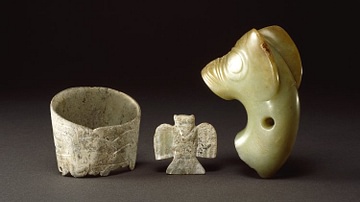
Chinese Jade Pig-Dragon, Owl & Hair Ornament
A jade hair ornament (?), owl figurine and pig-dragon. Hongshan Culture, c. 3,500 BCE. From Liaoning Province, China. (British Museum, London)
Image
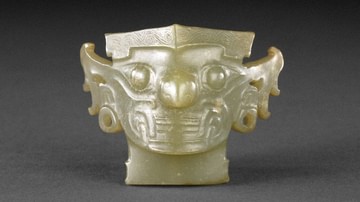
Chinese Jade mask
A Chinese miniature jade mask. 2nd millennium BCE. Height: 4 cm. (British Museum, London)

Image
Chinese Jade Cormorant
A Chinese jade plaque of a cormorant and fish. 1100-900 BCE. Height: 4 cm. (British Museum, London)

Image
Longshan Jade Blade
A ceremonial blade carved from jade by the Longshan culture of north-east China, 3000-1700 BCE. Length: 15.8 cm. (British Museum, London)

Image
Bird Figure, Jade Museum
Jade Museum, San Jose, Costa Rica
