
Search
Remove Ads
Advertisement
Search Results
Definition
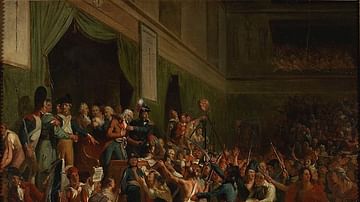
Prairial Uprising
The Uprising of 1 Prairial Year III (20 May 1795) was the last major popular insurrection during the French Revolution (1789-1799). It was the final time that the sans-culottes played an important role in French politics until...

Definition
George II of Great Britain
George II of Great Britain (r. 1727-1760) was the second of the Hanoverian monarchs, and like his father George I of Great Britain (r. 1714-1727), he faced a Jacobite rebellion to restore the Stuart line. Wars in Europe...

Definition
Corinth
Corinth was a Greek, Hellenistic and Roman city located on the isthmus which connects mainland Greece with the Peloponnese. Surrounded by fertile plains and blessed with natural springs, ancient Corinth was a centre of trade, had a naval...

Definition
Sasanian Empire
The Sasanian Empire (224-651 CE, also given as Sassanian, Sasanid or Sassanid) was the last pre-Islamic Persian empire, established in 224 CE by Ardeshir I, son of Papak, descendant of Sasan. The Empire lasted until 651 CE when...

Definition
Nikephoros II Phokas
Nikephoros II Phokas was Byzantine emperor from 963 to 969 CE. Known as “White Death of the Saracens,” Nikephoros was a fearsome commander who conquered Crete, Cilicia, and much of Syria. While he is known as a great military...
Definition
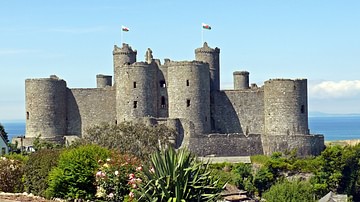
Harlech Castle
Harlech Castle, located in North Wales, was first built by Edward I of England (r. 1272-1307 CE) from 1283 CE. Largely completed by 1290 CE, the castle received some further additions up to 1330 CE. A classic example of a concentric...

Definition
Charles Cornwallis
Charles Cornwallis (1738-1805), 1st Marquess and 2nd Earl Cornwallis, was a British military officer and statesman best known for surrendering to George Washington at the Siege of Yorktown, the final decisive engagement of the...

Definition
Seleucid Empire
The Seleucid Empire (312-63 BCE) was the vast political entity established by Seleucus I Nicator ("Victor" or "Unconquered", l. c. 358-281 BCE, r. 305-281 BCE), one of the generals of Alexander the Great who claimed a part of...

Definition
Norse Mythology
Norse mythology refers to the Scandinavian mythological framework that was upheld during and around the time of the Viking Age (c. 790- c. 1100 CE). Complete with a creation myth that has the first gods slaying a giant and turning...

Definition
Vandals
The Vandals were a Germanic tribe who are first mentioned in Roman history in the Natural History of Pliny the Elder (77 CE). The Roman historian Tacitus also mentions them in his Germania (c. 98 CE), though he also refers to them as...
