
Search
Remove Ads
Advertisement
Search Results

Article
The Nazca Lines: A Life's Work
The World Heritage-listed Nazca lines are a well-known part of the ancient heritage of Peru. One woman spent over 50 years studying and protecting them. Ana Maria Cogorno Mendoza shares the story of Dr Maria Reiche...

Image
Minaret Top, Ali Mosque, Isfahan
The minaret of the Ali Mosque Manar, Isfahan, Iran (1118-1157 CE). Erected during the reign of Seljuk sultan Sanjar (118-1157 CE). Decorated by two balconies. The shaft below the balconies embellished with interlocking...

Image
Mihrab, Anjar
Mihrab or niche in the wall of a mosque at Anjar (8th century CE) that indicates the qibla or direction to Mecca, decorated by an apex arch lintel carved with vegetal carving above Byzantine characters.

Image
Tombstone of Caliph Umar
Tombstone of Caliph Umar (634 - 644 CE) of the Rashidun Caliphate, in Al-Masjid al-Nabawi, Medina. The grave of Umar can be seen from the first window on the right.
Image
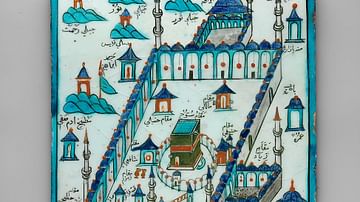
Ka'ba Tile
This rectangular tile depicts a stylized view of Mecca, with the black-shrouded Ka‘ba in the center of the Masjid al-Haram and other buildings within and around the holy sanctuary. It is part of a larger material corpus related to...

Image
Gar Minaret, Isfahan
The Gar Minaret, Gar (east of Isfahan), Iran. An inscription reveals its date as 1121 CE. Decorated with square Kufic inscriptions that are carved into the brick shaft.

Image
Arch, Anjar
An arch from the ruins of Anjar (8th century CE) in modern Lebanon. The structure recalls Roman architectural archways.
Image
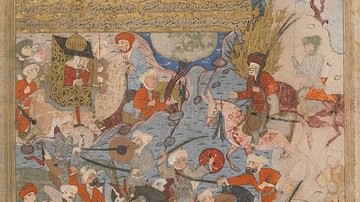
Ali & Aisha at the Battle of the Camel
A painting from manuscript of the "Rawdat al-safa" (Persian for "Gardens of Purity") made in Iran c. 1571 - 1572 CE. The painting depicts Ali (r. 656 - 661 CE) and Aisha (c. 613 - 678 CE), who led the opposing...

Image
Sarban Minaret, Isfahan
The Sarban ('Camel-driver') minaret at Isfahan (Jubareh area), Iran (1130-1155 CE). The shafts are decorated with alternate bands of decorative brick and blue tile work in geometric patterns, and two girdles of stalactite...

Image
General View, Anjar
A general view of Anjar (8th century CE) which illustrates the plan of the city, clearly showing the rationality of Umayyad town planning. The organic medieval cities that were eventually to house the Palace, Mosque, Souq...
