
Search
Remove Ads
Advertisement
Search Results

Article
Early Muslim Conquests (622-656 CE)
Islam arose as a religious and socio-political force in Arabia in the 7th century CE (610 CE onwards). The Islamic Prophet Muhammad (l. 570-632 CE), despite facing resistance and persecution, amassed a huge following and started building...

Image
The Classical Orders of Architecture - From Greece to Rome, the Five Pillars of Architectural Design
The five classical orders of architecture: Doric, Ionic, Corinthian, Tuscan, and Composite, form a codified system of proportion, decoration, and structural logic that emerged in the Greek world (c. 7th–4th centuries BCE) and was later adapted...

Image
The Doric Order, Classical Orders of Architecture
The Classical Orders of Architecture (Doric, Ionic, Corinthian, Tuscan, and Composite), originating in ancient Greece and refined by the Romans, are fundamental design principles that significantly influence classical and neoclassical structures...

Definition
Rashidun Caliphate
The first four caliphs of the Islamic empire – Abu Bakr, Umar, Uthman, and Ali are referred to as Rashidun (rightly guided) Caliphs (632-661 CE) by mainstream Sunni Muslims. Their tenure started with the death of Prophet Muhammad in 632 CE...

Definition
Abu Bakr
Abu Bakr (l. 573-634 CE, r. 632-634 CE) was an early convert of Islam; he was a close friend and confidant of the Islamic Prophet Muhammad, and became the first caliph of the Islamic empire – a successor to Muhammad's temporal position but...
Image
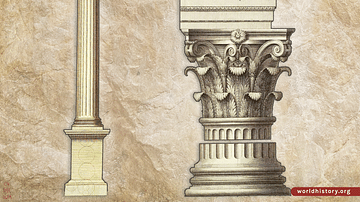
The Corinthian Order, Classical Orders of Architecture
The Classical Orders of Architecture (Doric, Ionic, Corinthian, Tuscan, and Composite), originating in ancient Greece and refined by the Romans, are fundamental design principles that significantly influence classical and neoclassical structures...
Image
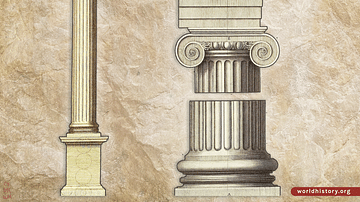
The Ionic Order, Classical Orders of Architecture
The Classical Orders of Architecture (Doric, Ionic, Corinthian, Tuscan, and Composite), originating in ancient Greece and refined by the Romans, are fundamental design principles that significantly influence classical and neoclassical structures...

Definition
Prophet Muhammad
Muhammad ibn Abdullah (l. 570-632 CE) is venerated today as the Prophet of Islam and the “seal of Prophets” by his followers – the Muslims. Muslims believe that Muhammad was the last – hence the “seal” – of many prophets before him in Judaism...

Definition
Quran
The Quran (also written Qur’an or Koran), revealed in the 7th century, is the sacred book of Islam, following in the tradition of the Abrahamic faiths, with the Torah as the sacred book of Judaism and the New Testament as the sacred book...
Image
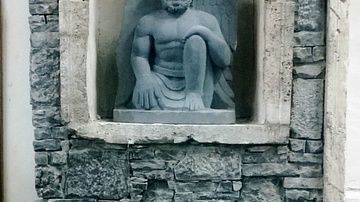
Reconstruction of Gandharan Architecture
A wall panel recreated using typical materials and decorative techniques at Quaid-e-Azam University to showcase Gandharan Architecture for students. The panel contains a structural wall created using typical small diaper masonry, with some...
