
Search
Remove Ads
Advertisement
Search Results

Article
Chariots in Ancient Indian Warfare
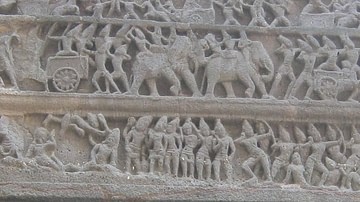
The chariot was the elite arm of ancient Indian armies in the Vedic (1500 BCE – 1000 BCE) and Epic periods (described by the Ramayana and the Mahabharata, 1000-600 BCE) because of the advantages it conferred and the selection of plain ground...
Article
Elephants In Ancient Indian Warfare
Elephants were used in the ancient Indian army, irrespective of regions, dynasties, or points in time; their importance was never denied and continued well into the medieval period as well. The ready availability in the subcontinent of the...

Definition
French and Indian War - The Final Clash of Empires in North America
The French and Indian War (1754-1763) was the last great colonial conflict waged between Great Britain and France in North America. Often considered a theater of the global Seven Years' War (1756-1763), it was sparked over a territorial dispute...
Image
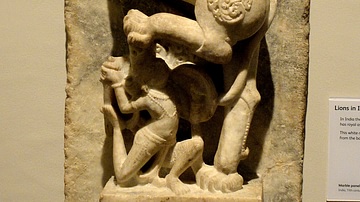
Sculpture of an Indian Lion
In India, the lion is known as the Lord of Beasts and has royal associations. This marble white panel is an architectural figure from the base of an Indian temple. From India, 11th century CE. (National Museum of Scotland, Edinburgh, UK)

Article
George Washington in the French and Indian War
The life and career of George Washington (1732-1799) were largely impacted by the French and Indian War (1754-1763). An officer of the Virginia Regiment, Washington's actions at the Battle of Fort Necessity and the Braddock Expedition helped...

Article
Cycladic Sculpture
The Cycladic islands of the Aegean were first inhabited by voyagers from Asia Minor around 3000 BCE and a certain prosperity was achieved thanks to the wealth of natural resources on the islands such as gold, silver, copper, obsidian and...

Article
Cultural Links between India & the Greco-Roman World
Cyrus the Great (558-530 BCE) built the first universal empire, stretching from Greece to the Indus River. This was the famous Achaemenid Empire of Persia. An inscription at Naqsh-i-Rustam, the tomb of his able successor Darius I (521-486...
Definition
Sepoy
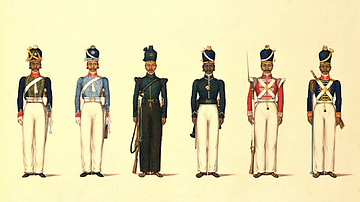
A sepoy was an Indian soldier in the armies of various states and European trading companies in the Indian subcontinent and then, from the second half of the 19th century, in the British Indian Army. Recruited from many different population...

Article
Etruscan Bronze Sculpture
The Etruscans produced bronze goods going back to the Villanovan period (1100-750 BCE) and used the material for all manner of objects, but it is their figure sculptures which have become some of the star attractions in museums worldwide...

Definition
Sepoy Mutiny
The 1857-8 Sepoy Mutiny (aka Sepoy Rebellion, Indian Mutiny, The Uprising or First Indian War of Independence) was a failed rebellion against the rule of the British East India Company (EIC) in India. Initially a mutiny of the Indian soldiers...
