
Search
Remove Ads
Advertisement
Search Results

Article
The Armies of the East India Company
The East India Company (EIC) was first England's and then Britain's tool of colonial expansion in India and beyond. Revenue from trade and land taxes from territories it controlled allowed the EIC to build up its...

Article
Hesiod on the Birth of the Gods
The Greek poet Hesiod (c. 700 BCE) is most famous for his works Theogony and Works and Days. In this passage from Theogony, Hesiod relates the birth of the gods from cosmic Chaos and follows the lineage through the...

Definition
Henry Every
Henry Every (b. 1653), also known as Henry Avery, Benjamin Bridgeman, ‘Long Ben’ and (incorrectly) John Avery, was one of the most savage and successful pirates in the Golden Age of Piracy. Capturing a treasure ship of the Mughal...

Video
How did Polynesian Wayfinders Navigate the Pacific Ocean
Learn more about TED-Ed Clubs here: https://ed.ted.com/clubs Visit the TED-Ed Clubs YouTube channel: https://www.youtube.com/channel/UCskU_g7t6b5ecsA1CTS3y9Q View full lesson: https://ed.ted.com/lessons/how-did-polynesian-wayfinders-navigate-the-pacific-ocean-alan-tamayose-and-shantell-de-silva...

Image
Ancient Indian Ship
This relief depicts an ancient Indian ship likely to have been used by Indian adventurers sailing to Java, Indonesia.
Location: Borobudur temple, Magelang, Central Java, Indonesia

Definition
Vasco da Gama
Vasco da Gama (c. 1469-1524) was a Portuguese navigator who, in 1497-9, sailed around the Cape of Good Hope in southern Africa and arrived at Calicut (now Kozhikode) on the south-west coast of India. This was the first direct voyage...

Interview
Interview: Bejeweled Sri Lanka
The first comprehensive survey of Sri Lankan art organized by an American museum, The Jeweled Isle: Art from Sri Lanka, on show now at the LACMA in Los Angeles, California, presents some 250 works addressing nearly...
Image
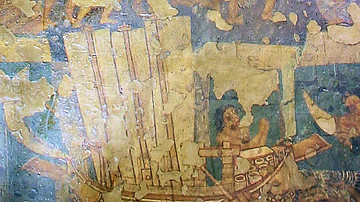
Ancient Indian Ship
This Ajanta mural depicts an ancient Indian ship with high stem and stern and three oblong sails attached to three masts. Steering-oars can also be seen. Location: Cave No. 2, Ajanta Caves, Aurangabad District, Maharashtra...

Image
Map of the Indian Rebellion (Sepoy Mutiny) of 1857
The Indian Rebellion of 1857 was a transformative uprising that shook British rule in South Asia. Sparked in May 1857 by mutinous sepoys ((from Persian sepāhī, for soldier)) of the East India Company...

Article
Battle of Hydaspes
For almost a decade, Alexander the Great and his army swept across Western Asia and into Egypt, defeating King Darius III and the Persians at the battles of River Granicus, Issus and Gaugamela. Next, despite the objections of...
