
Search
Remove Ads
Advertisement
Search Results

Definition
Caesarion
Ptolemy XV Caesar “Theos Philopator Philometor” (“the Father-loving Mother-loving God”) (c. 47-30 BCE), better known by his unofficial nickname Caesarion or “Little Caesar” in Greek, was the oldest son of Cleopatra VII (69-30 BCE...

Definition
Aria
Aria (or Areia) was always understood to be the area around the Areios River, today Hari Rud in Afghanistan (Arrian, Anabasis IV.6.6). It was bounded to the north by Margiana and Bactria, where the area of the Margos River begins; to the...

Definition
Jainism
Jainism is one of the oldest religions in the world. The name comes from jiva (soul or life force but, capitalized, is also given as Spiritual Conqueror) as it maintains that all living things possess an immortal soul which has always...

Definition
Vardhamana
Vardhamana (l. c. 599-527 BCE), better known as Mahavira (“Great Hero”) is the sage credited with founding of the nontheistic religion of Jainism, a belief system established in the 6th and 5th centuries BCE in India, which provided...

Definition
Druid
Druids were a class of individuals in ancient Celtic cultures known for their great wisdom and knowledge of traditions. Not only priests who managed all religious rituals such as sacrifices (including humans), druids were able to give...
Definition
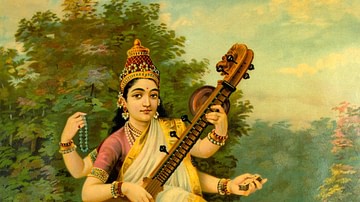
Saraswati
Saraswati (also Sarasvati) is the Hindu goddess of learning, wisdom, music, and aesthetics. She is also known as Bharati (eloquence), Shatarupa (existence), Vedamata ('mother of the Vedas'), Brahmi, Sarada, Vagisvari, and Putkari...
Definition
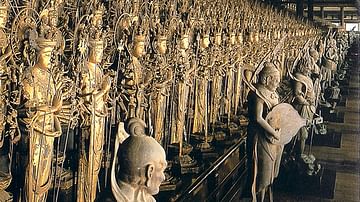
Sanjusangendo
Sanjusangendo is a Buddhist temple which is part of the Rengeo-in monastery in Kyoto, Japan. Founded in 1164 CE, the temple is famous for its impressive dimensions and the 1,001 golden Buddha figures and 28 guardian statues which...

Definition
Salado Culture
The Salado culture is a term used by historians and archaeologists to describe a pre-Columbian Southwestern culture that flourished from c. 1200-1450 CE in the Tonto Basin of what is now the southern parts of the present-day US...
Definition
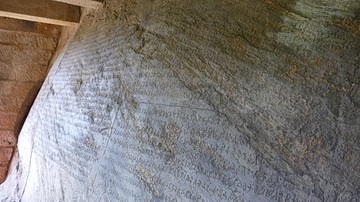
The Edicts of Ashoka the Great
The Edicts of Ashoka are 33 inscriptions engraved on pillars, large stones, and cave walls by Ashoka the Great (r. 268-232 BCE), the third king of the Mauryan Empire (322-185 BCE) of India. One set, the so-called Major...

Definition
Hobbamock
Hobbamock (d. c. 1643, also given as Hobbamok and Hobomok) was a Native American of the Pokanoket tribe who served the sachem Massasoit (l. c. 1581-1661) of the Wampanoag Confederacy as a pniese (counselor and elite warrior). He is...
