
Search
Did you mean: Cimon?
Remove Ads
Advertisement
Search Results

Article
The Letters of Paul the Apostle to the Gentiles
Paul was a member of the Jewish Pharisees in the 1st century CE, who experienced a revelation of the resurrected Jesus Christ. In this vision, Jesus commissioned him to be the apostle (herald) to the Gentiles...

Article
A Supervisor's Advice to a Young Scribe - Words of Wisdom or Satire?
A Supervisor's Advice to a Young Scribe is a Sumerian composition relating a dialogue between an elder scribe and a young graduate from his school. The piece is dated to the Old Babylonian...

Article
Twelve Famous Women of the Middle Ages
Women in the Middle Ages were frequently characterized as second-class citizens by the Church and the patriarchal aristocracy. Women's status was somewhat elevated in the High and Late Middle Ages by the cult...

Article
Pliny the Younger on Christianity
Pliny the Younger's (61-112 CE) letter (Epistulae X.96) to Roman Emperor Trajan (r. 98-117 CE) is one of our earliest sources on Christianity from an outsider's point of view. It highlights the Christian movement's...

Article
Inanna and Ebih - A Poetic Narrative on Feminine Power
Inanna and Ebih is a Sumerian/Akkadian poem attributed to Enheduanna (circa 2300 BCE), daughter of Sargon of Akkad. The work's original title is Inninmehusa ("Goddess of the Fearsome Powers") and...

Article
15 Complete Hyangga Songs from Ancient Korea
Hyangga was a form poetical 'country song,' distinct from contemporary Chinese songs, which were written in the Silla and Goryeo kingdoms of ancient Korea between the 7th and 10th century CE. The indigenous...

Article
Monotheism in the Ancient World
Monotheism is simply defined as the belief in one god and is usually positioned as the polar opposite of polytheism, the belief in many gods. However, the word monotheism is a relatively modern one that was coined...

Article
The Principate of Augustus
Augustus (r. 27 BCE to 14 CE), as the adopted son and heir of Julius Caesar (100-44 BCE), brought an end to the Roman Republic, and on 16 January 27 BCE, by Senatorial decree, he became the first Roman emperor. However...
Article
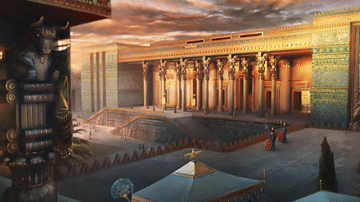
Herodotus: On The Customs of the Persians
Although the Greek historian Herodotus (l. c. 484-425/413 BCE) is often criticized for inaccuracy in his Histories, his frequently-anthologized On the Customs of the Persians is regarded as accurate. The passage...

Article
Enheduanna - Poet, Priestess, Empire Builder - Redefining the Gods for the People
Enheduanna (circa 2300 BCE) is the world's first author and was the daughter (either literally or figuratively) of the great empire-builder Sargon of Akkad (reign 2334-2279 BCE...
