
Search
Did you mean: Lydia?
Remove Ads
Advertisement
Search Results
Definition
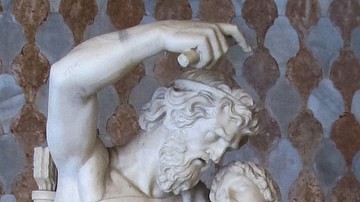
Chiron
Chiron (also spelt Cheiron) is a wise centaur (half-man, half-horse) in Greek mythology, who was a friend and tutor to many legendary Greek heroes, including Achilles and Jason. Chiron's parentage differed from the rest of the centaurs...

Definition
Deianira
Deianira was the second wife of the Greek hero and demi-god Herakles (better known as Hercules, son of the god Zeus and the mortal woman Alcmene). She was the daughter of King Oeneus and Queen Althaea of Calydon. During the time of...

Article
Enuma Elish - The Babylonian Epic of Creation - Full Text
The Enuma Elish (also known as The Seven Tablets of Creation) is the Babylonian creation myth whose title is derived from the opening lines of the piece, "When on High". The myth tells the story...

Article
A Visual Who's Who of Greek Mythology
Achilles The hero of the Trojan War, leader of the Myrmidons, slayer of Hector and Greece's greatest warrior, who sadly came unstuck when Paris sent a flying arrow guided by Apollo, which caught him in his...

Definition
Greek Mythology
Greek mythology was used as a means to explain the environment in which humankind lived, the natural phenomena they witnessed and the passing of time through the days, months, and seasons. Greek myths were also intricately connected...

Definition
Hera
Hera (Roman name: Juno) is the wife of Zeus and queen of the ancient Greek gods. Hera represented the ideal woman, was the goddess of marriage and the family, and protectress of women in childbirth. Hera was always faithful to Zeus but...

Definition
Theogony
The Theogony is an 8th-century BCE didactic and instructional poem, credited to the Greek poet Hesiod. The Theogony was, at first, not actually written down, rather, it was part of a rich oral tradition which only achieved written form...

Definition
Centaur
A centaur was a creature from Greek mythology which was half-man and half-horse. The head, arms and torso of a centaur were human and joined at the waist to the body and legs of a horse. Centaurs represented barbarism and unbridled chaos...

Definition
Typhon
Typhon (also Typheus) is the largest and most dreadful monster in Greek mythology. He was tall, with a brutish face, and had wings, countless snakeheads in place of hands, and a lower body made up of coiled serpents. His eyes flashed...

Definition
Pluto
Pluto is the god of the Underworld in Roman mythology. His Greek counterpart was Hades. Pluto chose never to sit on Olympus with the other gods and goddesses, preferring to remain in the Underworld. Family Pluto (Hades) was the son...
