
Search
Remove Ads
Advertisement
Search Results

Definition
Quetzalcóatl
Quetzalcóatl (pron. Quet-zal-co-at) or 'Plumed Serpent' was one of the most important gods in ancient Mesoamerica. Quetzalcóatl was the god of winds and rain, and the creator of the world and humanity. A mix of bird and rattlesnake...

Definition
Akhenaten
Akhenaten (r. 1353-1336 BCE) was a pharaoh of 18th Dynasty of the New Kingdom of Egypt. He is also known as 'Akhenaton' or 'Ikhnaton' and also 'Khuenaten', all of which are translated to mean 'successful for' or 'of great use to' the...

Definition
Ahuitzotl
Ahuitzotl (Auitzotl) was an Aztec ruler who reigned between 1486 and 1502 CE. He was one of the greatest generals of the ancient Americas and he left to his nephew, Montezuma, an enlarged and consolidated empire which had been ruthlessly...
Definition
Plotinus
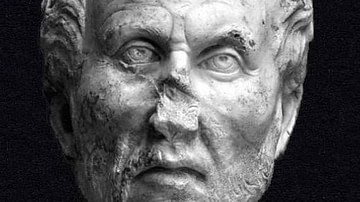
Plotinus (c. 204-270) was a Platonic philosopher born in Lycopolis, Egypt. Although the story of his life was written down by his student Porphyry, few biographical details are included because Plotinus rejected the physical world of...

Definition
Apophis
Apophis (also known as Apep) is the Great Serpent, enemy of the sun god Ra, in ancient Egyptian religion. The sun was Ra's great barge which sailed through the sky from dawn to dusk and then descended into the underworld. As it sailed...
Definition
Pachacamac
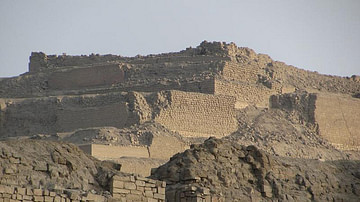
Pachacamac, located on the coast of Peru and 32 km south of Lima, was an important sacred site, oracle, and place of burial, which was visited by pilgrims of many ancient Andean cultures, including the Incas. The site, active for...

Definition
Ma'at
Ma'at (pronounced may-et) is the ancient Egyptian goddess of truth, justice, harmony, and balance (a concept known as ma'at in Egyptian) who first appears during the period known as the Old Kingdom (c. 2613 - 2181 BCE) but no doubt existed...
Definition
Etruscan Pottery
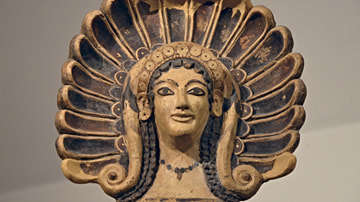
Etruscan pottery, produced over five centuries, was nothing if not varied. Indigenous wares such as the glossy black bucchero were made alongside red- and black-figure pottery imitating, yet modifying those produced in the Greek...

Definition
Constantine V
Constantine V, also known as Constantine the Dung-named by his enemies, was emperor of the Byzantine empire from 741 to 775 CE. He enjoyed military successes in the Middle East and Balkans but his reign is chiefly remembered for...

Definition
Fertile Crescent - A Modern Term For An Ancient Region
The Fertile Crescent, often called the 'cradle of civilization', is the region in the Middle East that curves like a quarter-moon shape from the Persian Gulf through modern-day southern Iraq, Syria...
